Ya gotta love it. First NASA names their first shuttle Enterprise, now they name their first "robonaut" R2 and it kinda looks like Boba Fett. I'll bet Mr. Lucas is happy.
Of course, you can't help but notice the blatant product endorsement.
R2 takes off for its permanent home on the ISS on Discovery's STS-133 flight scheduled in September.
--->Susan
Showing posts with label space news. Show all posts
Showing posts with label space news. Show all posts
30 April 2010


07 January 2010
Got Nova? NASA Don't.
 Scientists have been predicting for decades that as a massive star's nuclear fuel runs out, it begins to collapse under its own weight and the resulting pressure causes it to explode. Well, seems that's not the case and something is missing from the equation because what actually happens is that gravity takes over and the star collapses with a fizzle instead of a bang.
Novae of smaller suns are understood, but in order to find out what really happens with larger, massive stars, NASA is beginning work on a new space observatory they hope will help them find the missing data. Named NuSTAR or the Nuclear Spectroscopic Telescope Array, scheduled to launch in 2011 on a Pegasus rocket, its mission is to look inside a supernova as it explodes to observe the high-energy X-rays emitted. This will allow them to figure out what is happening inside the star and not merely on the outside.
 NuSTAR's optics has special coatings and configurations that allow it to reflect X-ray energy on to new sensors that can tolerate the high energy of high-intensity X-rays. As an added bonus, NuSTAR will also be able to focus on the X-ray emissions of supermassive black holes and blazars.
Keep tuned to Mystical Musings for more news here on Earth and beyond.
Enjoy!
--->Susan
Source: Science@NASA
NuSTAR Mission Home Page
05 January 2010
Photos from Space
Not much in the way of news today, so here are some photos to tickle your fancy.
Enjoy!
--->Susan

Artist's concept shows a cloudy Jupiter-like planet that orbits very close to its fiery hot star.

X-rays from Chandra are shown in blue and are overlaid on an optical image from the Hubble Space Telescope. The Chandra observations show that this object is a so-called ultraluminous X-ray source (ULX). An unusual class of objects, ULXs emit more X-rays than stars, but less than quasars. Their exact nature has remained a mystery, but one suggestion is that some ULXs are black holes with masses between about a hundred and a thousands times that of the Sun.

This image of a cluster of rocks labeled 'Rock Garden' is where NASA's Mars Exploration Rover Spirit became embedded in April 2009. The Spirit and Opportunity rovers landed on the Red Planet in January 2004 for what was to be a 90-day mission, but which has lasted 6 Earth years, or 3.2 Mars years. During this time, Spirit has found evidence of a steamy and violent environment on ancient Mars that is quite different from the wet and acidic past documented by Opportunity, which has been operating successfully as it explores halfway around the planet.

This natural-color image of Mayon Volcano was captured on Dec. 15, 2009, by the Advanced Land Imager on NASA's Earth Observing-1 (EO-1) satellite. A small plume of ash and steam is blowing west from the summit. Dark-colored lava or debris flows from previous eruptions streak the flanks of the mountain. A ravine on the southeast slope is occupied by a particularly prominent lava or debris flow.

The Cat's Eye Nebula taken by Hubble. The nebula is in the constellation of Draco approximately 3,000 light years from Earth.

Death of a comet. NASA's SOHO observatory took these series of shots of a comet getting just a bit too up close and personal with the sun. Comet goes in, but it doesn't come out. Oops. One less dirty snowball in the solar system to worry about.
Enjoy!
--->Susan

Artist's concept shows a cloudy Jupiter-like planet that orbits very close to its fiery hot star.

X-rays from Chandra are shown in blue and are overlaid on an optical image from the Hubble Space Telescope. The Chandra observations show that this object is a so-called ultraluminous X-ray source (ULX). An unusual class of objects, ULXs emit more X-rays than stars, but less than quasars. Their exact nature has remained a mystery, but one suggestion is that some ULXs are black holes with masses between about a hundred and a thousands times that of the Sun.

This image of a cluster of rocks labeled 'Rock Garden' is where NASA's Mars Exploration Rover Spirit became embedded in April 2009. The Spirit and Opportunity rovers landed on the Red Planet in January 2004 for what was to be a 90-day mission, but which has lasted 6 Earth years, or 3.2 Mars years. During this time, Spirit has found evidence of a steamy and violent environment on ancient Mars that is quite different from the wet and acidic past documented by Opportunity, which has been operating successfully as it explores halfway around the planet.

This natural-color image of Mayon Volcano was captured on Dec. 15, 2009, by the Advanced Land Imager on NASA's Earth Observing-1 (EO-1) satellite. A small plume of ash and steam is blowing west from the summit. Dark-colored lava or debris flows from previous eruptions streak the flanks of the mountain. A ravine on the southeast slope is occupied by a particularly prominent lava or debris flow.

The Cat's Eye Nebula taken by Hubble. The nebula is in the constellation of Draco approximately 3,000 light years from Earth.
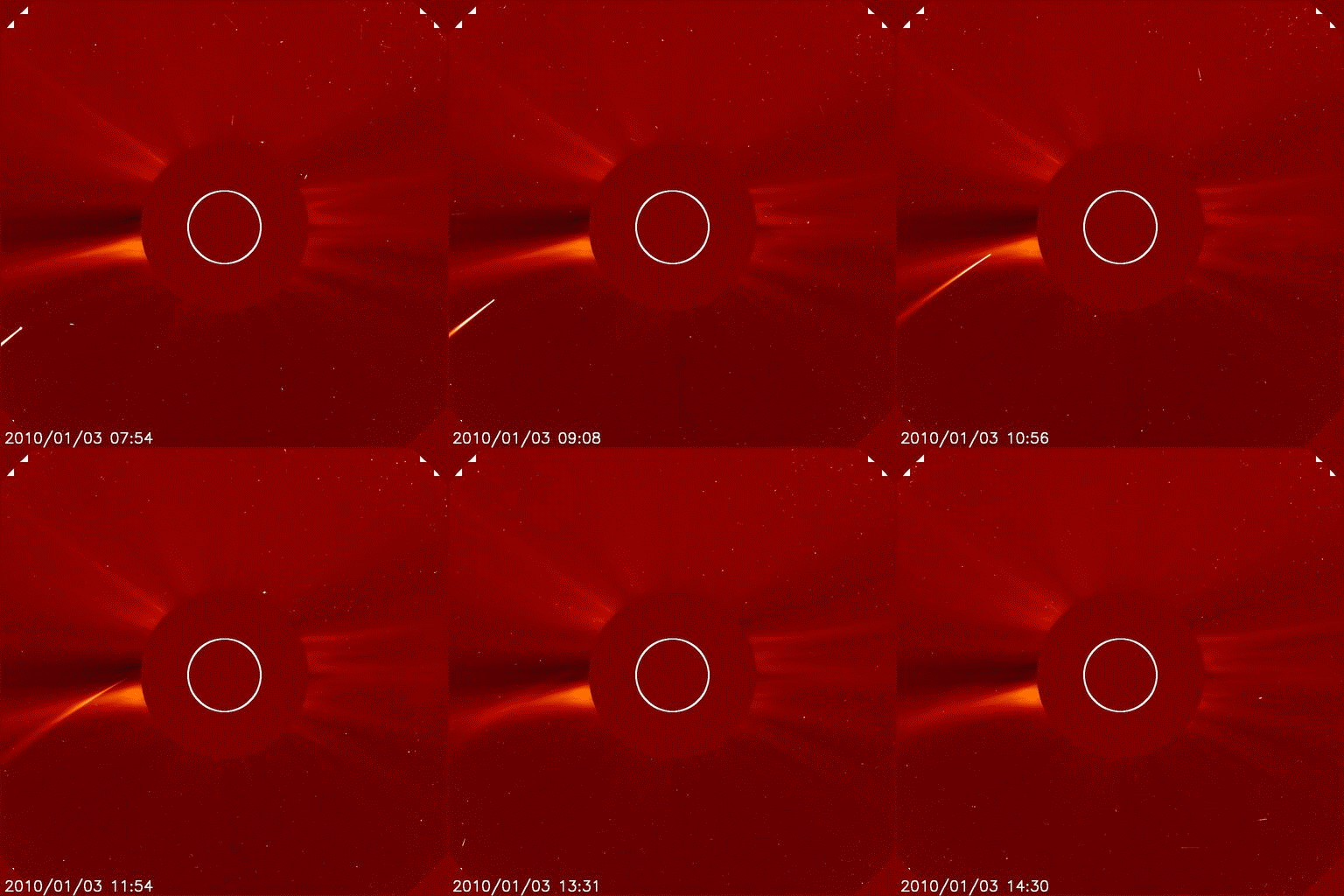
Death of a comet. NASA's SOHO observatory took these series of shots of a comet getting just a bit too up close and personal with the sun. Comet goes in, but it doesn't come out. Oops. One less dirty snowball in the solar system to worry about.
04 January 2010
Kepler Scores!

As reported here in Mystical Musings the other day, NASA said there would be an announcement regarding the Kepler space observatory launched last March to search for terrestrial-type planets. Today, they announced that the mission is already a success and five new exoplanets can be added to our catalogue.
Named Kepler 4b, 5b, 6b, 7b and 8b, the planets are all of high mass and extreme temperature and range in size from similar to Neptune to Jupiter and temperatures from 2,200 to 3,000 degrees Fahrenheit. That's a heck of a lot hotter than the temperature required to burn a book.

Kepler is expected to keep looking for planets until November 2012 and as the mission's head stated in the news briefing today, "The Kepler observations will tell us whether there are many stars with planets that could harbor life, or whether we might be alone in our galaxy."

Click here for more info on Kepler and its mission. The mission is named after German mathematician, astronomer and astrologer Johannes Kepler best known for his laws of planetary motion which led the way for Isaac Newton's theory of universal gravitation. Kepler proved that planets moved around the sun in elliptical orbits and not the circular orbits proposed by Copernicus. Along with Newton, Kepler gave rise to modern astronomy and physics.
Enjoy!
--->Susan
02 January 2010
2009 Year in Space
The year I was born – 1963 – was a very active year for space exploration with a  flyby of both the moon and Mars, 70 orbital launches (24 by the USSR and 46 by the USA). Only late the previously year, President Kennedy gave his famous "we choose to go to the moon" speech, effectively throwing down the space race gauntlet. Now, 47 years later, we're seeing some amazing things that would have been inconceivable back then. Since I was mainly absent from the space news blogging this year, I'll issue one post to recap the highlights.
Today, the race for space is no longer limited to two bullies dueling it out in the school yard. Instead we've got new contenders in the game, including one that is keeping a lot of people up at night. Among the new entries are New Zealand, Switzerland and Iran, who launched its first homemade satellite into orbit. The telecommunications and research satellite is designed to promote "monotheism, peace and justice" in the world." Um, yeah. That'll give me a few nightmares.
 The biggest news in the orbital launch category of 2009 wasn't one of the successful launches, but a failure. On April 5th, North Korea attempted to put a communication satellite into orbit. While the North Koreans insist the satellite was for peaceful purposes, the launch itself caused even President Obama to speak words as strong as his predecessor: "North Korea...has broke the rules...once again...by testing a rocket that could be used for long range missiles. Rules must be binding. Violations must be punished. Words must mean something. The world must stand together to prevent the spread to these weapons. It is time for an international response to prevent the spread of these weapons."
In all, there were 78 launches, with 73 successes (as opposed to the 50 successes of 1963). There were 4 new rockets including the Delta IV by Boeing, a Taurus and one each by Japan and South Korea. The European Space Agency and the Ukraine retired two rockets.
There were 9 manned flights and a total of 46 people travelled in space in 2009. Some of those folks were women and I won't even bother hunting down the statistics on that, but it's interesting to note that 1963 was the year a woman first traveled in space. (She was Soviet – it took another 20 years for an American woman to accomplish the same first.) Among the more memorable manned flights was STS-125, the final mission to repair the Hubble Space Telescope, certainly one of my favorite pieces of equipment in space (and BTW: the last person to touch the Hubble was a woman), and the 100th mission of the Soyuz space program to deliver astronauts to the International Space Station from the European Space Agency, the Russian Federal Space Agency, the Canadian Space Agency and NASA. Truly the space race has become integrated.
 Efforts in space exploration really shone during 2009, both close to home and at the outer reaches of the solar system. The Lunar Reconnaissance Orbiter was launched and already it is expanding our knowledge of the moon by providing detailed 3D maps to be used for future missions. More excitingly, the Lunar Crater Observation and Sensing Satellite (LCROSS) has already detected the presence of water on the moon, which will help NASA decide whether or not to build a manned base on the moon.
The Kepler Mission launched in March will explore the exoplanets other star systems to find more Earth-like planets rather than the big gas giants more easily seen. The Kepler telescope, although smaller in size than the Hubble, has a larger field of view and can view 100,000 stars at the same time. NASA plans on announcing some new discoveries from Kepler in a few days.
The Herschel Space Observatory will study light from not only without our own solar system and the Milky Way, but also galaxies beyond. It's looking at the small chemical composition of molecules and how they come together for form stars and galaxies. And the Plank spacecraft will study cosmic microwave background to test theories of the early universe and the origin of the cosmos. Both are projects of the European Space Agency. NASA and the JPL launched the Wide-Field Infrared Survey Explorer to make a complete picture of the sky in the infrared spectrum.
 In flybys, Cassini continues its mission around Saturn as recently reported in Mystical Musings. And speaking of mystical energy, Dawn used Mars's gravity to boost itself on its way to study the two largest objects in the asteroid belt Vesta and the dwarf planet Ceres. And the Messenger probe made its final pass by Mercury where it's been studying the planet from orbit. Messenger has discovered large amounts of water in Mercury's exosphere, dispelling myths that the closest planet to the sun is the driest. The ESA's Rosetta spacecraft performed its final gravity-assist flyby of the Earth on its way to study the comet 67P/Churyumov-Gerasimenko to help scientists unlock how the solar system looked before the planets formed.
What Comes Next?
 The Space Shuttle will retire and test flights of the SpaceX Dragon spacecraft will commence. This little capsule is reminiscent of the old Mercury, Gemini and Apollo space crafts, but it can carry up to 7 people or people and cargo, depending on its mission. Designed to be used to transport personnel to and from the ISS, the craft will be the main tool for the Commercial Orbital Transportation Services program NASA will use to coordinate commercial delivery of crew and cargo to and from the ISS. In other words, the space race is quickly and gleefully being outsourced to private business.
Japan plans to launch a probe to Venus to study lightning and volcanoes. And China will conduct another mission in preparation to land a probe on the moon.
Nine manned missions are planned to and from the ISS for crew rotations and cargo delivery. These will mark the final tasks of the space shuttles Atlantis, Endeavour and Discovery. In deep space, Cassini will continue its exploration of Titan and the other Saturnine moo ns Dione, Enceladus, Mimas, Rhea, and Tethys. Rosetta will fly by the asteroid 21 Lutetia and will hopefully tell us what it is made of and the Akatsuki probe will enter orbit around Venus near the end of the year. By the way, The Planetary Society is offering folks a chance to send a message to Venus along with Akatsuki so hurry and get yours in. I already did mine last month.
Keep an eyes on Mystical Musings as we journey through 2010 together in search of new and exiting space news.
--->Susan
 flyby of both the moon and Mars, 70 orbital launches (24 by the USSR and 46 by the USA). Only late the previously year, President Kennedy gave his famous "we choose to go to the moon" speech, effectively throwing down the space race gauntlet. Now, 47 years later, we're seeing some amazing things that would have been inconceivable back then. Since I was mainly absent from the space news blogging this year, I'll issue one post to recap the highlights.
Today, the race for space is no longer limited to two bullies dueling it out in the school yard. Instead we've got new contenders in the game, including one that is keeping a lot of people up at night. Among the new entries are New Zealand, Switzerland and Iran, who launched its first homemade satellite into orbit. The telecommunications and research satellite is designed to promote "monotheism, peace and justice" in the world." Um, yeah. That'll give me a few nightmares.
 The biggest news in the orbital launch category of 2009 wasn't one of the successful launches, but a failure. On April 5th, North Korea attempted to put a communication satellite into orbit. While the North Koreans insist the satellite was for peaceful purposes, the launch itself caused even President Obama to speak words as strong as his predecessor: "North Korea...has broke the rules...once again...by testing a rocket that could be used for long range missiles. Rules must be binding. Violations must be punished. Words must mean something. The world must stand together to prevent the spread to these weapons. It is time for an international response to prevent the spread of these weapons."
In all, there were 78 launches, with 73 successes (as opposed to the 50 successes of 1963). There were 4 new rockets including the Delta IV by Boeing, a Taurus and one each by Japan and South Korea. The European Space Agency and the Ukraine retired two rockets.
There were 9 manned flights and a total of 46 people travelled in space in 2009.
 Some of those folks were women and I won't even bother hunting down the statistics on that, but it's interesting to note that 1963 was the year a woman first traveled in space. (She was Soviet – it took another 20 years for an American woman to accomplish the same first.) Among the more memorable manned flights was STS-125, the final mission to repair the Hubble Space Telescope, certainly one of my favorite pieces of equipment in space (and BTW: the last person to touch the Hubble was a woman), and the 100th mission of the Soyuz space program to deliver astronauts to the International Space Station from the European Space Agency, the Russian Federal Space Agency, the Canadian Space Agency and NASA. Truly the space race has become integrated.
 Efforts in space exploration really shone during 2009, both close to home and at the outer reaches of the solar system. The Lunar Reconnaissance Orbiter was launched and already it is expanding our knowledge of the moon by providing detailed 3D maps to be used for future missions. More excitingly, the Lunar Crater Observation and Sensing Satellite (LCROSS) has already detected the presence of water on the moon, which will help NASA decide whether or not to build a manned base on the moon.
The Kepler
 Mission launched in March will explore the exoplanets other star systems to find more Earth-like planets rather than the big gas giants more easily seen. The Kepler telescope, although smaller in size than the Hubble, has a larger field of view and can view 100,000 stars at the same time. NASA plans on announcing some new discoveries from Kepler in a few days.
The Herschel Space Observatory will study light from not only without our own solar system and the Milky Way, but also galaxies beyond. It's looking at the small chemical composition of molecules and how they come together for form stars and galaxies. And the Plank spacecraft will study cosmic microwave background to test theories of the early universe and the origin of the cosmos. Both are projects of the European Space Agency. NASA and the JPL launched the Wide-Field Infrared Survey Explorer to make a complete picture of the sky in the infrared spectrum.
 In flybys, Cassini continues its mission around Saturn as recently reported in Mystical Musings. And speaking of mystical energy, Dawn used Mars's gravity to boost itself on its way to study the two largest objects in the asteroid belt Vesta and the dwarf planet Ceres. And the Messenger probe made its final pass by Mercury where it's been studying the planet from orbit. Messenger has discovered large amounts of water in Mercury's exosphere, dispelling myths that the closest planet to the sun is the driest. The ESA's Rosetta spacecraft performed its final gravity-assist flyby of the Earth on its way to study the comet 67P/Churyumov-Gerasimenko to help scientists unlock how the solar system looked before the planets formed.
What Comes Next?
 The Space Shuttle will retire and test flights of the SpaceX Dragon spacecraft will commence. This little capsule is reminiscent of the old Mercury, Gemini and Apollo space crafts, but it can carry up to 7 people or people and cargo, depending on its mission. Designed to be used to transport personnel to and from the ISS, the craft will be the main tool for the Commercial Orbital Transportation Services program NASA will use to coordinate commercial delivery of crew and cargo to and from the ISS. In other words, the space race is quickly and gleefully being outsourced to private business.
Japan plans to launch a probe to Venus to study lightning and volcanoes. And China
 will conduct another mission in preparation to land a probe on the moon.
Nine manned missions are planned to and from the ISS for crew rotations and cargo delivery. These will mark the final tasks of the space shuttles Atlantis, Endeavour and Discovery. In deep space, Cassini will continue its exploration of Titan and the other Saturnine moo
 ns Dione, Enceladus, Mimas, Rhea, and Tethys. Rosetta will fly by the asteroid 21 Lutetia and will hopefully tell us what it is made of and the Akatsuki probe will enter orbit around Venus near the end of the year. By the way, The Planetary Society is offering folks a chance to send a message to Venus along with Akatsuki so hurry and get yours in. I already did mine last month.
Keep an eyes on Mystical Musings as we journey through 2010 together in search of new and exiting space news.
--->Susan
18 December 2009
Here There Be Monsters
It's been a while since I posted about space news here. Things have been...well, hard enough here on Earth that I haven't been paying much attention to what's happening beyond our atmosphere, but this photo caught my eye.

It was taken by the probe Cassini and shows the reflection of the sun off of a lake of liquid hydrocarbons in the northern hemisphere of Saturn's moon Titan. The lake is named Kraken Mare and is about 400,000 square kilometers (150,000 square miles). By comparison, Lake Superior is 82,414 square kilometers (31,820 square miles).
No, it's not water, but it is exciting because it's proof that liquid does exist on the surface of a celestial body other than Earth. And that lake of hydrocarbons could represent an unimaginable source of energy that we'll be able to use someday.
Plans are already in the works to visit Titan and the Kraken Mare with the Titan Saturn System Mission, but liftoff won't be until after 2020.
The Cassini-Huygens probe was launched in 1997 and its primary mission objectives include studying the composition of Saturn's rings and the geology of Titan. So far, it has exceeded NASA's expectation and the 3.26B cost has been well spent.
The lake is named after the legendary sea monster. Tennyson wrote a poem about it:
In our lifetimes we may never know if monsters lurk beneath Kraken Mare on Titan, but at least we know liquid hydrocarbons do. And science is always more real than science fiction.
Cheers!
--->Susan

It was taken by the probe Cassini and shows the reflection of the sun off of a lake of liquid hydrocarbons in the northern hemisphere of Saturn's moon Titan. The lake is named Kraken Mare and is about 400,000 square kilometers (150,000 square miles). By comparison, Lake Superior is 82,414 square kilometers (31,820 square miles).
No, it's not water, but it is exciting because it's proof that liquid does exist on the surface of a celestial body other than Earth. And that lake of hydrocarbons could represent an unimaginable source of energy that we'll be able to use someday.
Plans are already in the works to visit Titan and the Kraken Mare with the Titan Saturn System Mission, but liftoff won't be until after 2020.
The Cassini-Huygens probe was launched in 1997 and its primary mission objectives include studying the composition of Saturn's rings and the geology of Titan. So far, it has exceeded NASA's expectation and the 3.26B cost has been well spent.
The lake is named after the legendary sea monster. Tennyson wrote a poem about it:
Below the thunders of the upper deep;
Far far beneath in the abysmal sea,
His ancient, dreamless, uninvaded sleep
The Kraken sleepeth: faintest sunlights flee
About his shadowy sides; above him swell
Huge sponges of millennial growth and height;
And far away into the sickly light,
From many a wondrous grot and secret cell
Unnumber'd and enormous polypi
Winnow with giant arms the slumbering green.
There hath he lain for ages, and will lie
Battening upon huge seaworms in his sleep,
Until the latter fire shall heat the deep;
Then once by man and angels to be seen,
In roaring he shall rise and on the surface die.
In our lifetimes we may never know if monsters lurk beneath Kraken Mare on Titan, but at least we know liquid hydrocarbons do. And science is always more real than science fiction.
Cheers!
--->Susan
02 December 2008
News from the 'Verse
Aurorae on Mars
The aurorae phenomenon has been confirmed on Mars by the infrared atmospheric spectronometer on the Mars Express Orbiter. The lights are not visible in regular light. Mars doesn't generate a planet-wide magentic field like here on Earth, so our aurorae will always be prettier.

Artist's rendition of the Mars Express Orbiter
Intersystem Visitor
Comet Machholz 1, discovered in 1986, has such a bizarre chemical makeup that scientists now believe it may have come from beyond our solar system. David Schleicher, a planetary astronomer at Lowell Observatory in Arizona.believes that Machholz 1 could be an interstellar interloper. He's found that the comet contains much less of a carbon-nitrogen molecule called cyanogen compared with the average found in other comets.

This image taken by the ESA-NASA sunwatching spacecraft SOHO reveals Comet Machholz 1 close to the sun on Jan. 8, 2002. SOHO's coronograph hid the bright sun, the size of which is shown by the inner ring. Credit: SOHO/LASCO (ESA & NASA).
Exoplanetary News
A newly discovered exoplanet nearly six times the mass of Jupiter was discovered orbiting the red giant star HD 102272, which is located 1,200 light-years away in the constellation Leo. The researchers detected the planet with the Hobby-Eberly Telescope of McDonald Observatory in Texas. They used the radial velocity method, which involves measuring the slight wobbles of a star caused by the tug of an orbiting planet.

This artist's impression shows a red supergiant engulfing a Jupiter-like planet as it expands. The red giant HD 102272 will likely not engulf its planet for another 100 million years when it begins to mushroom dramatically. Credit: NASA
Great Conjunction
I hope y'all got a good look outside last night at the amazing skyshow of the Moon, Jupiter and Venus. I tried to get some pics, but forgot to set up the tripod in time so I missed it. However, here are some shots for your enjoyment.


Lunar Conjunction
Romanian photographer Stanescu Octavian took this picture of the moon running over Venus. These happen just twice a year with the next being February 28, 2009 and will be wonderfully visible here in North America.

NEO News
That's all!
--->Susan
The aurorae phenomenon has been confirmed on Mars by the infrared atmospheric spectronometer on the Mars Express Orbiter. The lights are not visible in regular light. Mars doesn't generate a planet-wide magentic field like here on Earth, so our aurorae will always be prettier.

Artist's rendition of the Mars Express Orbiter
Intersystem Visitor
Comet Machholz 1, discovered in 1986, has such a bizarre chemical makeup that scientists now believe it may have come from beyond our solar system. David Schleicher, a planetary astronomer at Lowell Observatory in Arizona.believes that Machholz 1 could be an interstellar interloper. He's found that the comet contains much less of a carbon-nitrogen molecule called cyanogen compared with the average found in other comets.

This image taken by the ESA-NASA sunwatching spacecraft SOHO reveals Comet Machholz 1 close to the sun on Jan. 8, 2002. SOHO's coronograph hid the bright sun, the size of which is shown by the inner ring. Credit: SOHO/LASCO (ESA & NASA).
Exoplanetary News
A newly discovered exoplanet nearly six times the mass of Jupiter was discovered orbiting the red giant star HD 102272, which is located 1,200 light-years away in the constellation Leo. The researchers detected the planet with the Hobby-Eberly Telescope of McDonald Observatory in Texas. They used the radial velocity method, which involves measuring the slight wobbles of a star caused by the tug of an orbiting planet.

This artist's impression shows a red supergiant engulfing a Jupiter-like planet as it expands. The red giant HD 102272 will likely not engulf its planet for another 100 million years when it begins to mushroom dramatically. Credit: NASA
Great Conjunction
I hope y'all got a good look outside last night at the amazing skyshow of the Moon, Jupiter and Venus. I tried to get some pics, but forgot to set up the tripod in time so I missed it. However, here are some shots for your enjoyment.


Lunar Conjunction
Romanian photographer Stanescu Octavian took this picture of the moon running over Venus. These happen just twice a year with the next being February 28, 2009 and will be wonderfully visible here in North America.

NEO News
On December 2, 2008 there were 1002 potentially hazardous asteroids.
 |
Dec. 2008 Earth-asteroid encounters:
| Asteroid | Date(UT) | Miss Distance | Mag. | Size |
| 2008 WY94 | Dec. 5 | 3.2 LD | 19 | 35 m |
| 2008 WG14 | Dec. 5 | 4.8 LD | 17 | 49 m |
| 2006 VB14 | Dec. 14 | 36 LD | 15 | 795 m |
| 2008 EV5 | Dec. 23 | 8.4 LD | 13 | 435 m |
That's all!
--->Susan
28 November 2008
Space News Roundup
Tools in Space!
The biggest news this week was STS-126's mission to the International Space Station to deliver equipment and make necessary upgrades to double the number of crew the ISS can support – to a big total of six. Among the most amusing aspects of the mission: Astronaut Heidemarie Stefanyshyn-Piper lost a tool bag containing tools valued at $100,000 during a spacewalk. Fortunately it did not pose a danger to the station or the shuttle and is now a part of the floating space debris orbiting our planet. Take a look at the bag filmed from this side:
While Captain Stefanyshyn-Piper took responsibility for the loss of the valuable equipment, I challenge those who criticize her to do what she does. Take a look at the view from her office and see if you can work in those conditions:

The Endeavour will return home on Sunday at 13:18 EST (18:18 UTC).
And speaking of satellites: Here's a nifty site that lets you know what objects will be floating over your home tonight: Satellite Tracker.
A Husband and Wife Reunion
NASA is gearing up for a new mission to Jupiter. The Juno mission will place a spacecraft in an elliptical orbit around the red giant to study its formation, evolution and structure. The mission will be launched from Cape Canaveral, Florida in August 2011 and will reach Jupiter in 2016. It will also be the first solar-powered spacecraft to operate so far from the sun, proving the great advances in solar technology made in recent years.

Glaciers on Mars
NASA's Mars Reconnaissance Orbiter has revealed vast glaciers of water ice under rocky debris at much lower latitudes than any ice previously identified on Mars. Scientists are very excited about the find because it will mean future manned exploration missions will have access to water far away from the polar caps.

Maybe someday we'll be able to go skiing on the Glaciers of Mars just like The Governator did in Total Recall.
No Longer just the WORLDwide Web
NASA successfully tested the first deep space communication network using software based on the Internet, with the intent that it will be an interplanetary internet system. Engineers from NASA's Jet Propulsion Laboratory in Pasadena, Calif., used software called Disruption-Tolerant Networking, or DTN, to transmit dozens of space images to and from a NASA science spacecraft located about more than 32 million kilometers (20 million miles) from Earth.

In the next few years, the Interplanetary Internet could enable different missions involving multiple landed, mobile and orbiting spacecraft. Communications between the differing systems will be far easier to support through the use of the Interplanetary Internet. It could also ensure reliable communications for astronauts on the surface of the moon.
Thanksgiving Sunspot
A new sunspot formed on Thanksgiving. Take a peek of this close-up:

But seriously, a sunspot was beginning to form, but it fizzled away.
Near-Earth Objects
Notes: LD means "Lunar Distance." 1 LD = 384,401 km, the distance between Earth and the Moon. 1 LD also equals 0.00256 AU. MAG is the visual magnitude of the asteroid on the date of closest approach.
Aurora News
The auroras this month were caused mainly by two solar wind streams hitting Earth, one on Nov. 7th and another on Nov. 24th. Here's a movie taken November 26th.
And two more pics from this week:


Space Weather Today
Solar wind
speed: 490.9 km/sec
density: 0.9 protons/cm3
explanation | more data
Updated: Today at 1355 UT
X-ray Solar Flares
6-hr max: A0 1355 UT Nov28
24-hr: A0 1355 UT Nov28
explanation | more data
Updated: Today at: 1355 UT
Daily Sun: 28 Nov 08

The sun is blank--no sunspots. Yesterday's proto-sunspot has faded away. Credit: SOHO/MDI
Sunspot number: 0
What is the sunspot number?
Updated 27 Nov. 2008
Thanks to SpaceWeather.com and the NASA Homepage as well as the various photographers and artists for their information which is presented here for entertainment and self-educational purposes only. No copyright infringement is intended.
--->Susan
The biggest news this week was STS-126's mission to the International Space Station to deliver equipment and make necessary upgrades to double the number of crew the ISS can support – to a big total of six. Among the most amusing aspects of the mission: Astronaut Heidemarie Stefanyshyn-Piper lost a tool bag containing tools valued at $100,000 during a spacewalk. Fortunately it did not pose a danger to the station or the shuttle and is now a part of the floating space debris orbiting our planet. Take a look at the bag filmed from this side:
While Captain Stefanyshyn-Piper took responsibility for the loss of the valuable equipment, I challenge those who criticize her to do what she does. Take a look at the view from her office and see if you can work in those conditions:

The Endeavour will return home on Sunday at 13:18 EST (18:18 UTC).
And speaking of satellites: Here's a nifty site that lets you know what objects will be floating over your home tonight: Satellite Tracker.
A Husband and Wife Reunion
NASA is gearing up for a new mission to Jupiter. The Juno mission will place a spacecraft in an elliptical orbit around the red giant to study its formation, evolution and structure. The mission will be launched from Cape Canaveral, Florida in August 2011 and will reach Jupiter in 2016. It will also be the first solar-powered spacecraft to operate so far from the sun, proving the great advances in solar technology made in recent years.

Glaciers on Mars
NASA's Mars Reconnaissance Orbiter has revealed vast glaciers of water ice under rocky debris at much lower latitudes than any ice previously identified on Mars. Scientists are very excited about the find because it will mean future manned exploration missions will have access to water far away from the polar caps.

Maybe someday we'll be able to go skiing on the Glaciers of Mars just like The Governator did in Total Recall.
No Longer just the WORLDwide Web
NASA successfully tested the first deep space communication network using software based on the Internet, with the intent that it will be an interplanetary internet system. Engineers from NASA's Jet Propulsion Laboratory in Pasadena, Calif., used software called Disruption-Tolerant Networking, or DTN, to transmit dozens of space images to and from a NASA science spacecraft located about more than 32 million kilometers (20 million miles) from Earth.

In the next few years, the Interplanetary Internet could enable different missions involving multiple landed, mobile and orbiting spacecraft. Communications between the differing systems will be far easier to support through the use of the Interplanetary Internet. It could also ensure reliable communications for astronauts on the surface of the moon.
Thanksgiving Sunspot
A new sunspot formed on Thanksgiving. Take a peek of this close-up:

But seriously, a sunspot was beginning to form, but it fizzled away.
Near-Earth Objects
On November 28, 2008 there were 1002 potentially hazardous asteroids.
|
Nov. 2008 Earth-asteroid encounters:
| Asteroid | Date(UT) | Miss Distance | Mag. | Size |
| 2008 TX3 | Nov. 1 | 9 LD | 19 | 45 m |
| 2008 UT95 | Nov. 2 | 1.5 LD | 17 | 15 m |
| 2008 UC7 | Nov. 2 | 4.5 LD | 20 | 17 m |
| 2008 VM | Nov. 3 | 0.1 LD | 20 | 4 m |
| 2008 VA4 | Nov. 4 | 7.7 LD | 17 | 49 m |
| 2008 VB4 | Nov. 4 | 1.3 LD | 18 | 10 m |
| 2008 VC | Nov. 4 | 4.4 LD | 20 | 18 m |
| 4179 Toutatis | Nov. 9 | 20 LD | 14 | 3.8 km |
| 2008 WO2 | Nov. 16 | 1.0 LD | 20 | 5 m |
| 2004 XK3 | Nov. 18 | 1.8 LD | 15 | 60 m |
| 2008 VZ3 | Nov. 22 | 5.7 LD | 18 | 55 m |
| 2008 WD | Nov. 24 | 6.9 LD | 19 | 30 m |
| 2008 WC | Nov. 26 | 5.1 LD | 19 | 23 m |
| 2008 WM61 | Nov. 27 | 3.5 LD | 18 | 20 m |
|
Aurora News
The auroras this month were caused mainly by two solar wind streams hitting Earth, one on Nov. 7th and another on Nov. 24th. Here's a movie taken November 26th.
And two more pics from this week:


Space Weather Today
Solar wind
speed: 490.9 km/sec
density: 0.9 protons/cm3
explanation | more data
Updated: Today at 1355 UT
|
6-hr max: A0 1355 UT Nov28
24-hr: A0 1355 UT Nov28
explanation | more data
Updated: Today at: 1355 UT
|
|
|

|
|
What is the sunspot number?
Updated 27 Nov. 2008
Thanks to SpaceWeather.com and the NASA Homepage as well as the various photographers and artists for their information which is presented here for entertainment and self-educational purposes only. No copyright infringement is intended.
--->Susan
23 November 2008
Where Did All the Air Go?

Scientists are coming to the conclusion that the Martian atmosphere is slowly and steadily being stripped away by solar wind. The cause? Mars' magnetic field, which is quite different than the magnetosphere here on Earth. David Brain of UC Berkeley, using data from the Mars Global Surveyor, discovered that the Martian magnetic field is in the form of magnetic "umbrellas" that extend from the ground to beyond the atmosphere and cover about 40% of the planet's surface. The MGS discovered that on occasion, the umbrellas connect with the magnetic field of the solar wind and can trap huge chunks of atmosphere in magnetic capsules, or "plasmoids." The pressure from the wind then rips off these plasmoids and sends it out into space.

Solar wind blowing against Mars tears atmosphere-filled plasmoids from the tops of magnetic umbrellas.
Before the mystery is fully solved of what happened to the Martian atmosphere, NASA needs more data and they're planning on sending a new mission to Mars, called MAVEN or Martian Atmosphere and Volatile Evolution in 2013.

The Martian Atmosphere
Why is this important? We'll need to know what happened on Mars before we can attempt any effort to transform it into a planet more suitable for human life. There might not be anything we can do about the Martian magnetic field, but the more we know about what's happening there, the better chance we have. Humans are unique among species in that we don't adapt ourselves to survive in our environment; we adapt our environment in order to survive. That concept will surely extend to other planets if we plan on our long term survival.
For more info: Solar Wind Rips Up Martian Atmosphere.
That's all!
--->Susan
13 November 2008
We Are Not Alone
NASA has released photographs taken by the HST of another planet in another solar system.

Wow!
This is not an infrared image, this is not a radio image, and this is not an artist's rendition. This is an actual visible-light photograph of another planet in another solar system.
Wow again!
The system is a bright star called Fomalhaut, about 25 light-years from us in the constellation Piscis Australis, or the "Southern Fish." Scientists have long suspected their first glimpse of another planet would be in this system since data suggested a large body was causing gravitational distortions to a cloud of dust orbiting the star which is very similar to our Kuiper Belt.
Says one of the scientists on the project: "Fomalhaut is the gift that keeps on giving. Following the unexpected discovery of its dust ring, we have now found an exoplanet at a location suggested by analysis of the dust ring's shape. The lesson for exoplanet hunters is 'follow the dust'."
NASA has ambition plans for further study of the Fomalhaut system. They're planning on launching the James Webb Space Telescope in 2013. Its mission will be to make coronagraphic observations of Fomalhaut in the near- and mid-infrared. Webb will be able to hunt for other planets in the system and probe the region interior to the dust ring for structures such as an inner asteroid belt.

That's all!
--->Susan
Subscribe to:
Posts (Atom)