This photograph of the MarsJuventae Chasma canyon shows the different color variations in layered deposits of opaline silica and iron sulfates. The canyon is part of the large Valles Marineris rift which runs nearly 1/4 the way around the planet. The rift, so far the longest known in the solar system, is over 4,000 km long, 200 km wide and up to 7 km deep. By comparison, the Grand Canyon is 446 km long, 29 km wide and 1.83 km deep.
The aurorae phenomenon has been confirmed on Mars by the infrared atmospheric spectronometer on the Mars Express Orbiter. The lights are not visible in regular light. Mars doesn't generate a planet-wide magentic field like here on Earth, so our aurorae will always be prettier.
Artist's rendition of the Mars Express Orbiter
Intersystem Visitor
Comet Machholz 1, discovered in 1986, has such a bizarre chemical makeup that scientists now believe it may have come from beyond our solar system. David Schleicher, a planetary astronomer at Lowell Observatory in Arizona.believes that Machholz 1 could be an interstellar interloper. He's found that the comet contains much less of a carbon-nitrogen molecule called cyanogen compared with the average found in other comets.
This image taken by the ESA-NASA sunwatching spacecraft SOHO reveals Comet Machholz 1 close to the sun on Jan. 8, 2002. SOHO's coronograph hid the bright sun, the size of which is shown by the inner ring. Credit: SOHO/LASCO (ESA & NASA).
Exoplanetary News
A newly discovered exoplanet nearly six times the mass of Jupiter was discovered orbiting the red giant star HD 102272, which is located 1,200 light-years away in the constellation Leo. The researchers detected the planet with the Hobby-Eberly Telescope of McDonald Observatory in Texas. They used the radial velocity method, which involves measuring the slight wobbles of a star caused by the tug of an orbiting planet.
This artist's impression shows a red supergiant engulfing a Jupiter-like planet as it expands. The red giant HD 102272 will likely not engulf its planet for another 100 million years when it begins to mushroom dramatically. Credit: NASA
Great Conjunction
I hope y'all got a good look outside last night at the amazing skyshow of the Moon, Jupiter and Venus. I tried to get some pics, but forgot to set up the tripod in time so I missed it. However, here are some shots for your enjoyment.
Lunar Conjunction
Romanian photographer Stanescu Octavian took this picture of the moon running over Venus. These happen just twice a year with the next being February 28, 2009 and will be wonderfully visible here in North America.
NEO News
On December 2, 2008 there were 1002 potentially hazardous asteroids.
The biggest news this week was STS-126's mission to the International Space Station to deliver equipment and make necessary upgrades to double the number of crew the ISS can support – to a big total of six. Among the most amusing aspects of the mission: Astronaut Heidemarie Stefanyshyn-Piper lost a tool bag containing tools valued at $100,000 during a spacewalk. Fortunately it did not pose a danger to the station or the shuttle and is now a part of the floating space debris orbiting our planet. Take a look at the bag filmed from this side:
While Captain Stefanyshyn-Piper took responsibility for the loss of the valuable equipment, I challenge those who criticize her to do what she does. Take a look at the view from her office and see if you can work in those conditions:
The Endeavour will return home on Sunday at 13:18 EST (18:18 UTC).
And speaking of satellites: Here's a nifty site that lets you know what objects will be floating over your home tonight: Satellite Tracker.
A Husband and Wife Reunion
NASA is gearing up for a new mission to Jupiter. The Juno mission will place a spacecraft in an elliptical orbit around the red giant to study its formation, evolution and structure. The mission will be launched from Cape Canaveral, Florida in August 2011 and will reach Jupiter in 2016. It will also be the first solar-powered spacecraft to operate so far from the sun, proving the great advances in solar technology made in recent years.
Glaciers on Mars
NASA's Mars Reconnaissance Orbiter has revealed vast glaciers of water ice under rocky debris at much lower latitudes than any ice previously identified on Mars. Scientists are very excited about the find because it will mean future manned exploration missions will have access to water far away from the polar caps.
Maybe someday we'll be able to go skiing on the Glaciers of Mars just like The Governator did in Total Recall.
No Longer just the WORLDwide Web
NASA successfully tested the first deep space communication network using software based on the Internet, with the intent that it will be an interplanetary internet system. Engineers from NASA's Jet Propulsion Laboratory in Pasadena, Calif., used software called Disruption-Tolerant Networking, or DTN, to transmit dozens of space images to and from a NASA science spacecraft located about more than 32 million kilometers (20 million miles) from Earth.
In the next few years, the Interplanetary Internet could enable different missions involving multiple landed, mobile and orbiting spacecraft. Communications between the differing systems will be far easier to support through the use of the Interplanetary Internet. It could also ensure reliable communications for astronauts on the surface of the moon.
Thanksgiving Sunspot
A new sunspot formed on Thanksgiving. Take a peek of this close-up:
But seriously, a sunspot was beginning to form, but it fizzled away.
Notes: LD means "Lunar Distance." 1 LD = 384,401 km, the distance between Earth and the Moon. 1 LD also equals 0.00256 AU. MAG is the visual magnitude of the asteroid on the date of closest approach.
The auroras this month were caused mainly by two solar wind streams hitting Earth, one on Nov. 7th and another on Nov. 24th. Here's a movie taken November 26th.
And two more pics from this week:
Space Weather Today
Solar wind speed: 490.9 km/sec density: 0.9 protons/cm3 explanation | more data Updated: Today at 1355 UT
X-ray Solar Flares 6-hr max: A0 1355 UT Nov28 24-hr: A0 1355 UT Nov28 explanation | more data Updated: Today at: 1355 UT
Daily Sun: 28 Nov 08
The sun is blank--no sunspots. Yesterday's proto-sunspot has faded away. Credit: SOHO/MDI
Thanks to SpaceWeather.com and the NASA Homepage as well as the various photographers and artists for their information which is presented here for entertainment and self-educational purposes only. No copyright infringement is intended.
Scientists are coming to the conclusion that the Martian atmosphere is slowly and steadily being stripped away by solar wind. The cause? Mars' magnetic field, which is quite different than the magnetosphere here on Earth. David Brain of UC Berkeley, using data from the Mars Global Surveyor, discovered that the Martian magnetic field is in the form of magnetic "umbrellas" that extend from the ground to beyond the atmosphere and cover about 40% of the planet's surface. The MGS discovered that on occasion, the umbrellas connect with the magnetic field of the solar wind and can trap huge chunks of atmosphere in magnetic capsules, or "plasmoids." The pressure from the wind then rips off these plasmoids and sends it out into space.
Solar wind blowing against Mars tears atmosphere-filled plasmoids from the tops of magnetic umbrellas.
Before the mystery is fully solved of what happened to the Martian atmosphere, NASA needs more data and they're planning on sending a new mission to Mars, called MAVEN or Martian Atmosphere and Volatile Evolution in 2013.
The Martian Atmosphere
Why is this important? We'll need to know what happened on Mars before we can attempt any effort to transform it into a planet more suitable for human life. There might not be anything we can do about the Martian magnetic field, but the more we know about what's happening there, the better chance we have. Humans are unique among species in that we don't adapt ourselves to survive in our environment; we adapt our environment in order to survive. That concept will surely extend to other planets if we plan on our long term survival.
Nasa reports that the Phoenix Martian lander's mission is now over. The hearty little craft finally ran out of power, not due to the expanding Martian winter, but rather a dust storm that blocked the sun from its solar panels.
Nasa's expectations and hopes for the Phoenix mission were met even though the lander didn't last as long as it was hoped. The lander was the first to touch water on another planet, a historic accomplishment in itself.
Scientists will be analyzing the date received from Phoenix for many years to come.
What plans for the future?
The Planetary Society will give a press conference on Nov. 13 to discuss what plans they would like to see in the near future and taking into consideration the current economic situation.
For more on the future of spaceflight and space tourism, visit Nasa's Future of Flight site.
The Phoenix Mars lander mission is quickly coming to an end as the staunch little probe runs out of energy. The cause is the decreasing sunlight of the Martian arctic site and dust kicked up by storms.
This animation shows how NASA's Phoenix Mars Lander stays in contact with Earth. Image credit: NASA/JPL-Caltech/University of Arizona
Little Phoenix will continue broadcasting until the end.
A Sexy Love Triangle
Photographer Shannon L. Story of Texas got a shot of Venus, Jupiter and the Moon as makes its way to a triangular gathering peaking on December 1st.
Sunspot 1007
Photographer Alan Friedman took this shot from his backyard of sunspot 1007. Says Friedman, "It's filamentary, my dear Watson!" The image does bear a curious resemblance to the pipe of Sherlock Holmes.
This is an artist's conception of what is called a flux transfer event or 'FTE,' a magnetic portal will open, linking Earth to the sun 93 million miles away. Tons of high-energy particles may flow through the opening before it closes again. And this happens nearly once every eight minutes.
Cool, huh?
Blogger's Note: The information and images are from Nasa's Space Weather Site. This is presented with links to additional information for self-educational purposes only. No copyright infringement is intended.
Duck and Cover From Nasa's Space Weather. It looks like they're doing something right.
A small, newly-discovered asteroid named 2008 TC3 is approaching Earth and chances are better than 99.8% that it will hit. Steve Chesley of NASA's Jet Propulsion Laboratory estimates that atmospheric entry will occur on Oct 7th at 0246 UTC over northern Sudan--just hours from now. Measuring only a few meters across, the space rock poses NO THREAT to people or structures on the ground, but it should create a spectacular fireball, releasing about a kiloton of TNT in energy as it disintegrates and explodes in the atmosphere. Asteroids of this size hit Earth every few months, but this is the first time one has been discovered before it hit.
It Never Rains in Southern Russia!
Saturday night, Oct. 4th, in Russia's Kolyskia peninsula, storm clouds gathered over Mt. Khibiny and the rain began to fall. Lo and behold, it was green.
Northern Lights posing as rain are a common occurance in this arctic part of Russia, where photographer Aleksander Chernucho keeps his Nikon D200 close at hand for midnight photo-ops. On this night, the clouds pulled back revealing a bank of auroras so bright they turned the harbor waters as green as the sky: photo. "Good storm!"
Earth is exiting the solar wind stream that caused the display, but another stream is on the way. Sky watchers around the Arctic Circle should be alert for auroras when it arrives on Oct. 8th or 9th.
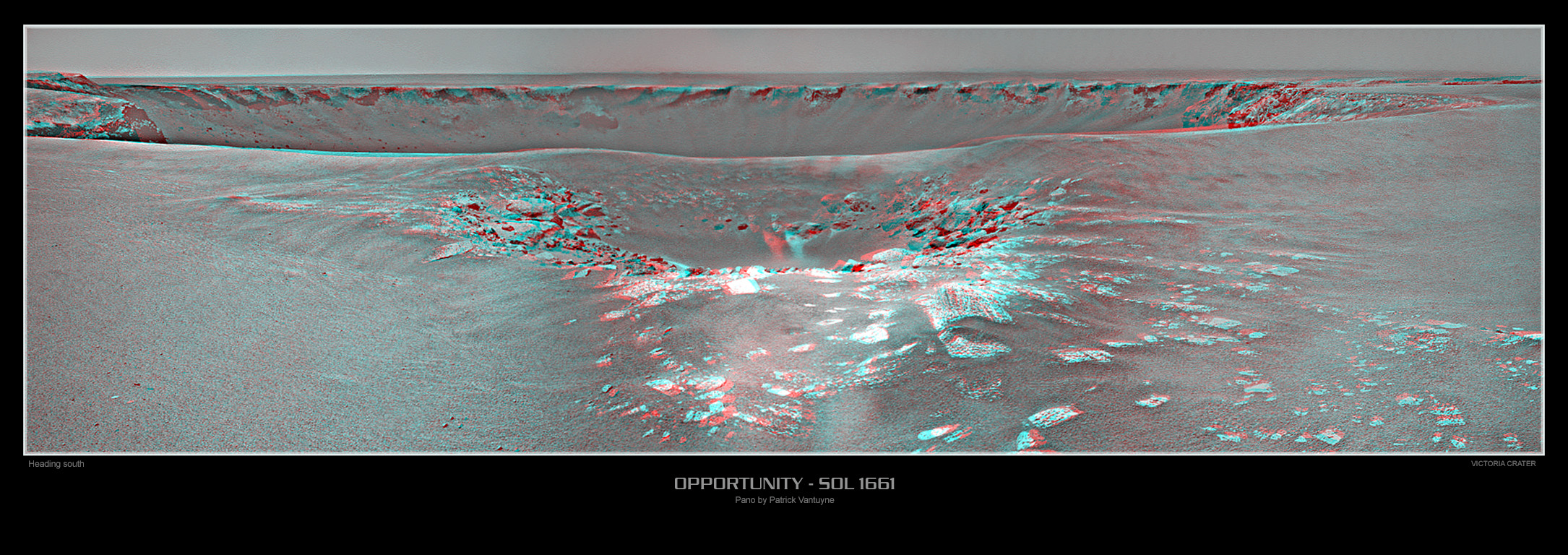
As the Rover Roves Sorry, they only had a 3D pic. Get out your Secret Agent Decoder Glasses to see it.
After spending a year inside Victoria Crater, Mars rover Opportunity has climbed out and resumed its travels across the red planet. Put on your 3D glasses and enjoy this view of one small crater near the rim of receding Victoria:
Graphic artist Patrick Vantuyne created the anaglyph by combining right- and left-eye images from Opportunity's stereo camera. The complete panorama, showing the entirety of Victoria crater in the background, is a must-see.
Next stop: Endeavor, a 14-mile wide crater some 20 times larger than Victoria. To get there, Opportunity will have to drive seven miles, matching the total distance it has traveled since landing on Mars in early 2004. The journey could take two years. "We may not make it, but scientifically speaking that's the right direction to go," says Steve Squyres of Cornell University. "Endeavour is staggeringly large compared to anything we've seen before." Squyres and colleagues hope that peering into the depths of Endeavour will yield new secrets from Mars' wet and wild past--and, oh, the 3D!