Showing posts with label comets. Show all posts

05 January 2010

Photos from Space

Not much in the way of news today, so here are some photos to tickle your fancy.

Enjoy!

--->Susan


Artist's concept shows a cloudy Jupiter-like planet that orbits very close to its fiery hot star.


X-rays from Chandra are shown in blue and are overlaid on an optical image from the Hubble Space Telescope. The Chandra observations show that this object is a so-called ultraluminous X-ray source (ULX). An unusual class of objects, ULXs emit more X-rays than stars, but less than quasars. Their exact nature has remained a mystery, but one suggestion is that some ULXs are black holes with masses between about a hundred and a thousands times that of the Sun.


This image of a cluster of rocks labeled 'Rock Garden' is where NASA's Mars Exploration Rover Spirit became embedded in April 2009. The Spirit and Opportunity rovers landed on the Red Planet in January 2004 for what was to be a 90-day mission, but which has lasted 6 Earth years, or 3.2 Mars years. During this time, Spirit has found evidence of a steamy and violent environment on ancient Mars that is quite different from the wet and acidic past documented by Opportunity, which has been operating successfully as it explores halfway around the planet.


This natural-color image of Mayon Volcano was captured on Dec. 15, 2009, by the Advanced Land Imager on NASA's Earth Observing-1 (EO-1) satellite. A small plume of ash and steam is blowing west from the summit. Dark-colored lava or debris flows from previous eruptions streak the flanks of the mountain. A ravine on the southeast slope is occupied by a particularly prominent lava or debris flow.


The Cat's Eye Nebula taken by Hubble. The nebula is in the constellation of Draco approximately 3,000 light years from Earth.
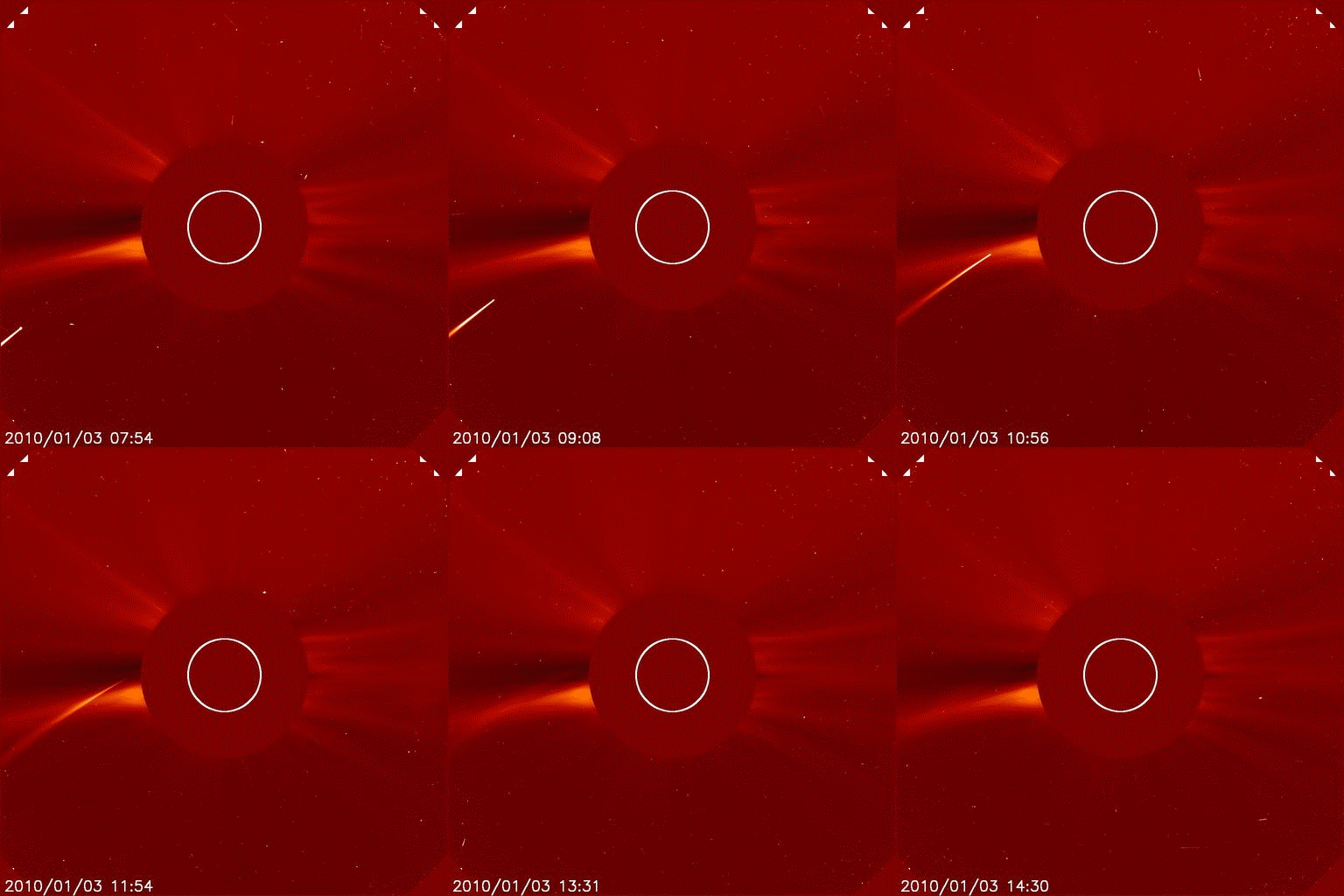

Death of a comet. NASA's SOHO observatory took these series of shots of a comet getting just a bit too up close and personal with the sun. Comet goes in, but it doesn't come out. Oops. One less dirty snowball in the solar system to worry about.

02 December 2008

News from the 'Verse

Aurorae on Mars

The aurorae phenomenon has been confirmed on Mars by the infrared atmospheric spectronometer on the Mars Express Orbiter. The lights are not visible in regular light. Mars doesn't generate a planet-wide magentic field like here on Earth, so our aurorae will always be prettier.


Artist's rendition of the Mars Express Orbiter


Intersystem Visitor

Comet Machholz 1, discovered in 1986, has such a bizarre chemical makeup that scientists now believe it may have come from beyond our solar system. David Schleicher, a planetary astronomer at Lowell Observatory in Arizona.believes that Machholz 1 could be an interstellar interloper. He's found that the comet contains much less of a carbon-nitrogen molecule called cyanogen compared with the average found in other comets.


This image taken by the ESA-NASA sunwatching spacecraft SOHO reveals Comet Machholz 1 close to the sun on Jan. 8, 2002. SOHO's coronograph hid the bright sun, the size of which is shown by the inner ring. Credit: SOHO/LASCO (ESA & NASA).


Exoplanetary News

A newly discovered exoplanet nearly six times the mass of Jupiter was discovered orbiting the red giant star HD 102272, which is located 1,200 light-years away in the constellation Leo. The researchers detected the planet with the Hobby-Eberly Telescope of McDonald Observatory in Texas. They used the radial velocity method, which involves measuring the slight wobbles of a star caused by the tug of an orbiting planet.


This artist's impression shows a red supergiant engulfing a Jupiter-like planet as it expands. The red giant HD 102272 will likely not engulf its planet for another 100 million years when it begins to mushroom dramatically. Credit: NASA


Great Conjunction

I hope y'all got a good look outside last night at the amazing skyshow of the Moon, Jupiter and Venus. I tried to get some pics, but forgot to set up the tripod in time so I missed it. However, here are some shots for your enjoyment.


Lunar Conjunction

Romanian photographer Stanescu Octavian took this picture of the moon running over Venus. These happen just twice a year with the next being February 28, 2009 and will be wonderfully visible here in North America.


NEO News

On December 2, 2008 there were 1002 potentially hazardous asteroids.
Dec. 2008 Earth-asteroid encounters:
Asteroid
Date(UT)
Miss Distance
Mag.
Size
2008 WY94
Dec. 5
3.2 LD
19
35 m
2008 WG14
Dec. 5
4.8 LD
17
49 m
2006 VB14
Dec. 14
36 LD
15
795 m
2008 EV5
Dec. 23
8.4 LD
13
435 m


That's all!

--->Susan
 
Add to Technorati Favorites