Ya gotta love it. First NASA names their first shuttle Enterprise, now they name their first "robonaut" R2 and it kinda looks like Boba Fett. I'll bet Mr. Lucas is happy.
Of course, you can't help but notice the blatant product endorsement.
R2 takes off for its permanent home on the ISS on Discovery's STS-133 flight scheduled in September.
--->Susan
Showing posts with label space. Show all posts
Showing posts with label space. Show all posts
30 April 2010


07 January 2010
Got Nova? NASA Don't.
 Scientists have been predicting for decades that as a massive star's nuclear fuel runs out, it begins to collapse under its own weight and the resulting pressure causes it to explode. Well, seems that's not the case and something is missing from the equation because what actually happens is that gravity takes over and the star collapses with a fizzle instead of a bang.
Novae of smaller suns are understood, but in order to find out what really happens with larger, massive stars, NASA is beginning work on a new space observatory they hope will help them find the missing data. Named NuSTAR or the Nuclear Spectroscopic Telescope Array, scheduled to launch in 2011 on a Pegasus rocket, its mission is to look inside a supernova as it explodes to observe the high-energy X-rays emitted. This will allow them to figure out what is happening inside the star and not merely on the outside.
 NuSTAR's optics has special coatings and configurations that allow it to reflect X-ray energy on to new sensors that can tolerate the high energy of high-intensity X-rays. As an added bonus, NuSTAR will also be able to focus on the X-ray emissions of supermassive black holes and blazars.
Keep tuned to Mystical Musings for more news here on Earth and beyond.
Enjoy!
--->Susan
Source: Science@NASA
NuSTAR Mission Home Page
18 December 2009
Here There Be Monsters
It's been a while since I posted about space news here. Things have been...well, hard enough here on Earth that I haven't been paying much attention to what's happening beyond our atmosphere, but this photo caught my eye.

It was taken by the probe Cassini and shows the reflection of the sun off of a lake of liquid hydrocarbons in the northern hemisphere of Saturn's moon Titan. The lake is named Kraken Mare and is about 400,000 square kilometers (150,000 square miles). By comparison, Lake Superior is 82,414 square kilometers (31,820 square miles).
No, it's not water, but it is exciting because it's proof that liquid does exist on the surface of a celestial body other than Earth. And that lake of hydrocarbons could represent an unimaginable source of energy that we'll be able to use someday.
Plans are already in the works to visit Titan and the Kraken Mare with the Titan Saturn System Mission, but liftoff won't be until after 2020.
The Cassini-Huygens probe was launched in 1997 and its primary mission objectives include studying the composition of Saturn's rings and the geology of Titan. So far, it has exceeded NASA's expectation and the 3.26B cost has been well spent.
The lake is named after the legendary sea monster. Tennyson wrote a poem about it:
In our lifetimes we may never know if monsters lurk beneath Kraken Mare on Titan, but at least we know liquid hydrocarbons do. And science is always more real than science fiction.
Cheers!
--->Susan

It was taken by the probe Cassini and shows the reflection of the sun off of a lake of liquid hydrocarbons in the northern hemisphere of Saturn's moon Titan. The lake is named Kraken Mare and is about 400,000 square kilometers (150,000 square miles). By comparison, Lake Superior is 82,414 square kilometers (31,820 square miles).
No, it's not water, but it is exciting because it's proof that liquid does exist on the surface of a celestial body other than Earth. And that lake of hydrocarbons could represent an unimaginable source of energy that we'll be able to use someday.
Plans are already in the works to visit Titan and the Kraken Mare with the Titan Saturn System Mission, but liftoff won't be until after 2020.
The Cassini-Huygens probe was launched in 1997 and its primary mission objectives include studying the composition of Saturn's rings and the geology of Titan. So far, it has exceeded NASA's expectation and the 3.26B cost has been well spent.
The lake is named after the legendary sea monster. Tennyson wrote a poem about it:
Below the thunders of the upper deep;
Far far beneath in the abysmal sea,
His ancient, dreamless, uninvaded sleep
The Kraken sleepeth: faintest sunlights flee
About his shadowy sides; above him swell
Huge sponges of millennial growth and height;
And far away into the sickly light,
From many a wondrous grot and secret cell
Unnumber'd and enormous polypi
Winnow with giant arms the slumbering green.
There hath he lain for ages, and will lie
Battening upon huge seaworms in his sleep,
Until the latter fire shall heat the deep;
Then once by man and angels to be seen,
In roaring he shall rise and on the surface die.
In our lifetimes we may never know if monsters lurk beneath Kraken Mare on Titan, but at least we know liquid hydrocarbons do. And science is always more real than science fiction.
Cheers!
--->Susan
28 November 2008
Space News Roundup
Tools in Space!
The biggest news this week was STS-126's mission to the International Space Station to deliver equipment and make necessary upgrades to double the number of crew the ISS can support – to a big total of six. Among the most amusing aspects of the mission: Astronaut Heidemarie Stefanyshyn-Piper lost a tool bag containing tools valued at $100,000 during a spacewalk. Fortunately it did not pose a danger to the station or the shuttle and is now a part of the floating space debris orbiting our planet. Take a look at the bag filmed from this side:
While Captain Stefanyshyn-Piper took responsibility for the loss of the valuable equipment, I challenge those who criticize her to do what she does. Take a look at the view from her office and see if you can work in those conditions:

The Endeavour will return home on Sunday at 13:18 EST (18:18 UTC).
And speaking of satellites: Here's a nifty site that lets you know what objects will be floating over your home tonight: Satellite Tracker.
A Husband and Wife Reunion
NASA is gearing up for a new mission to Jupiter. The Juno mission will place a spacecraft in an elliptical orbit around the red giant to study its formation, evolution and structure. The mission will be launched from Cape Canaveral, Florida in August 2011 and will reach Jupiter in 2016. It will also be the first solar-powered spacecraft to operate so far from the sun, proving the great advances in solar technology made in recent years.

Glaciers on Mars
NASA's Mars Reconnaissance Orbiter has revealed vast glaciers of water ice under rocky debris at much lower latitudes than any ice previously identified on Mars. Scientists are very excited about the find because it will mean future manned exploration missions will have access to water far away from the polar caps.

Maybe someday we'll be able to go skiing on the Glaciers of Mars just like The Governator did in Total Recall.
No Longer just the WORLDwide Web
NASA successfully tested the first deep space communication network using software based on the Internet, with the intent that it will be an interplanetary internet system. Engineers from NASA's Jet Propulsion Laboratory in Pasadena, Calif., used software called Disruption-Tolerant Networking, or DTN, to transmit dozens of space images to and from a NASA science spacecraft located about more than 32 million kilometers (20 million miles) from Earth.

In the next few years, the Interplanetary Internet could enable different missions involving multiple landed, mobile and orbiting spacecraft. Communications between the differing systems will be far easier to support through the use of the Interplanetary Internet. It could also ensure reliable communications for astronauts on the surface of the moon.
Thanksgiving Sunspot
A new sunspot formed on Thanksgiving. Take a peek of this close-up:

But seriously, a sunspot was beginning to form, but it fizzled away.
Near-Earth Objects
Notes: LD means "Lunar Distance." 1 LD = 384,401 km, the distance between Earth and the Moon. 1 LD also equals 0.00256 AU. MAG is the visual magnitude of the asteroid on the date of closest approach.
Aurora News
The auroras this month were caused mainly by two solar wind streams hitting Earth, one on Nov. 7th and another on Nov. 24th. Here's a movie taken November 26th.
And two more pics from this week:


Space Weather Today
Solar wind
speed: 490.9 km/sec
density: 0.9 protons/cm3
explanation | more data
Updated: Today at 1355 UT
X-ray Solar Flares
6-hr max: A0 1355 UT Nov28
24-hr: A0 1355 UT Nov28
explanation | more data
Updated: Today at: 1355 UT
Daily Sun: 28 Nov 08

The sun is blank--no sunspots. Yesterday's proto-sunspot has faded away. Credit: SOHO/MDI
Sunspot number: 0
What is the sunspot number?
Updated 27 Nov. 2008
Thanks to SpaceWeather.com and the NASA Homepage as well as the various photographers and artists for their information which is presented here for entertainment and self-educational purposes only. No copyright infringement is intended.
--->Susan
The biggest news this week was STS-126's mission to the International Space Station to deliver equipment and make necessary upgrades to double the number of crew the ISS can support – to a big total of six. Among the most amusing aspects of the mission: Astronaut Heidemarie Stefanyshyn-Piper lost a tool bag containing tools valued at $100,000 during a spacewalk. Fortunately it did not pose a danger to the station or the shuttle and is now a part of the floating space debris orbiting our planet. Take a look at the bag filmed from this side:
While Captain Stefanyshyn-Piper took responsibility for the loss of the valuable equipment, I challenge those who criticize her to do what she does. Take a look at the view from her office and see if you can work in those conditions:

The Endeavour will return home on Sunday at 13:18 EST (18:18 UTC).
And speaking of satellites: Here's a nifty site that lets you know what objects will be floating over your home tonight: Satellite Tracker.
A Husband and Wife Reunion
NASA is gearing up for a new mission to Jupiter. The Juno mission will place a spacecraft in an elliptical orbit around the red giant to study its formation, evolution and structure. The mission will be launched from Cape Canaveral, Florida in August 2011 and will reach Jupiter in 2016. It will also be the first solar-powered spacecraft to operate so far from the sun, proving the great advances in solar technology made in recent years.

Glaciers on Mars
NASA's Mars Reconnaissance Orbiter has revealed vast glaciers of water ice under rocky debris at much lower latitudes than any ice previously identified on Mars. Scientists are very excited about the find because it will mean future manned exploration missions will have access to water far away from the polar caps.

Maybe someday we'll be able to go skiing on the Glaciers of Mars just like The Governator did in Total Recall.
No Longer just the WORLDwide Web
NASA successfully tested the first deep space communication network using software based on the Internet, with the intent that it will be an interplanetary internet system. Engineers from NASA's Jet Propulsion Laboratory in Pasadena, Calif., used software called Disruption-Tolerant Networking, or DTN, to transmit dozens of space images to and from a NASA science spacecraft located about more than 32 million kilometers (20 million miles) from Earth.

In the next few years, the Interplanetary Internet could enable different missions involving multiple landed, mobile and orbiting spacecraft. Communications between the differing systems will be far easier to support through the use of the Interplanetary Internet. It could also ensure reliable communications for astronauts on the surface of the moon.
Thanksgiving Sunspot
A new sunspot formed on Thanksgiving. Take a peek of this close-up:

But seriously, a sunspot was beginning to form, but it fizzled away.
Near-Earth Objects
On November 28, 2008 there were 1002 potentially hazardous asteroids.
 |
Nov. 2008 Earth-asteroid encounters:
| Asteroid | Date(UT) | Miss Distance | Mag. | Size |
| 2008 TX3 | Nov. 1 | 9 LD | 19 | 45 m |
| 2008 UT95 | Nov. 2 | 1.5 LD | 17 | 15 m |
| 2008 UC7 | Nov. 2 | 4.5 LD | 20 | 17 m |
| 2008 VM | Nov. 3 | 0.1 LD | 20 | 4 m |
| 2008 VA4 | Nov. 4 | 7.7 LD | 17 | 49 m |
| 2008 VB4 | Nov. 4 | 1.3 LD | 18 | 10 m |
| 2008 VC | Nov. 4 | 4.4 LD | 20 | 18 m |
| 4179 Toutatis | Nov. 9 | 20 LD | 14 | 3.8 km |
| 2008 WO2 | Nov. 16 | 1.0 LD | 20 | 5 m |
| 2004 XK3 | Nov. 18 | 1.8 LD | 15 | 60 m |
| 2008 VZ3 | Nov. 22 | 5.7 LD | 18 | 55 m |
| 2008 WD | Nov. 24 | 6.9 LD | 19 | 30 m |
| 2008 WC | Nov. 26 | 5.1 LD | 19 | 23 m |
| 2008 WM61 | Nov. 27 | 3.5 LD | 18 | 20 m |
|
Aurora News
The auroras this month were caused mainly by two solar wind streams hitting Earth, one on Nov. 7th and another on Nov. 24th. Here's a movie taken November 26th.
And two more pics from this week:


Space Weather Today
Solar wind
speed: 490.9 km/sec
density: 0.9 protons/cm3
explanation | more data
Updated: Today at 1355 UT
|
6-hr max: A0 1355 UT Nov28
24-hr: A0 1355 UT Nov28
explanation | more data
Updated: Today at: 1355 UT
|
|
|

|
|
What is the sunspot number?
Updated 27 Nov. 2008
Thanks to SpaceWeather.com and the NASA Homepage as well as the various photographers and artists for their information which is presented here for entertainment and self-educational purposes only. No copyright infringement is intended.
--->Susan
23 November 2008
Where Did All the Air Go?

Scientists are coming to the conclusion that the Martian atmosphere is slowly and steadily being stripped away by solar wind. The cause? Mars' magnetic field, which is quite different than the magnetosphere here on Earth. David Brain of UC Berkeley, using data from the Mars Global Surveyor, discovered that the Martian magnetic field is in the form of magnetic "umbrellas" that extend from the ground to beyond the atmosphere and cover about 40% of the planet's surface. The MGS discovered that on occasion, the umbrellas connect with the magnetic field of the solar wind and can trap huge chunks of atmosphere in magnetic capsules, or "plasmoids." The pressure from the wind then rips off these plasmoids and sends it out into space.

Solar wind blowing against Mars tears atmosphere-filled plasmoids from the tops of magnetic umbrellas.
Before the mystery is fully solved of what happened to the Martian atmosphere, NASA needs more data and they're planning on sending a new mission to Mars, called MAVEN or Martian Atmosphere and Volatile Evolution in 2013.

The Martian Atmosphere
Why is this important? We'll need to know what happened on Mars before we can attempt any effort to transform it into a planet more suitable for human life. There might not be anything we can do about the Martian magnetic field, but the more we know about what's happening there, the better chance we have. Humans are unique among species in that we don't adapt ourselves to survive in our environment; we adapt our environment in order to survive. That concept will surely extend to other planets if we plan on our long term survival.
For more info: Solar Wind Rips Up Martian Atmosphere.
That's all!
--->Susan
13 November 2008
We Are Not Alone
NASA has released photographs taken by the HST of another planet in another solar system.

Wow!
This is not an infrared image, this is not a radio image, and this is not an artist's rendition. This is an actual visible-light photograph of another planet in another solar system.
Wow again!
The system is a bright star called Fomalhaut, about 25 light-years from us in the constellation Piscis Australis, or the "Southern Fish." Scientists have long suspected their first glimpse of another planet would be in this system since data suggested a large body was causing gravitational distortions to a cloud of dust orbiting the star which is very similar to our Kuiper Belt.
Says one of the scientists on the project: "Fomalhaut is the gift that keeps on giving. Following the unexpected discovery of its dust ring, we have now found an exoplanet at a location suggested by analysis of the dust ring's shape. The lesson for exoplanet hunters is 'follow the dust'."
NASA has ambition plans for further study of the Fomalhaut system. They're planning on launching the James Webb Space Telescope in 2013. Its mission will be to make coronagraphic observations of Fomalhaut in the near- and mid-infrared. Webb will be able to hunt for other planets in the system and probe the region interior to the dust ring for structures such as an inner asteroid belt.

That's all!
--->Susan
06 November 2008
The Taurids are Coming!
King Sol...

A solar wind stream flowing from this coronal hole could reach Earth on Nov. 6th or 7th. Credit: Hinode X-ray Telescope.
...and His Mighty Wind
A solar wind stream hit Earth on Oct. 28th sparking mild but beautiful geomagnetic storms around the Arctic Circle. Here are some lovely pics capturing the phenomenon.


Torrid Taurids
The annual Taurid meteor shower is underway and it could be a good show. 2008 is a "swarm year" for the Taurids: Between Nov. 5th and 12th, Earth is due to pass through a swarm of gritty debris from parent comet 2P/Encke.

Roman Piffl sends this report from Slovakia: "Last night, a very bright Taurid fireball streaked over the northern horizon of Marianka near our capital city Bratislava." He and colleagues Ivan Majchrovic and Tomas Maruska captured the meteor in this 30 second exposure with a Canon 5D.
That's all!
--->Susan
05 November 2008
A Hubble with a View
Bullet Cluster

Officially known as 1E 0657-56, the Bullet Cluster was formed after the violent collision of two large clusters of galaxies. Located about 3.8 billion light years from Earth, this image combines an image from NASA's Chandra X-ray Observatory with optical data from the Hubble Space Telescope and Magellan telescope in Chile. The cluster has become an extremely popular object for astrophysical research, including studies of the properties of dark matter and the dynamics of million-degree gas.
In this latest research effort, the Bullet Cluster was used to search for the presence of antimatter leftover from the very early universe. Antimatter is made up of elementary particles that have the same masses as their corresponding matter counterparts -- protons, neutrons and electrons -- but the opposite charges and magnetic properties.
Perfect 10

Just a few days after the orbiting observatory was brought back online, Hubble aimed its prime working camera, the Wide Field Planetary Camera 2 (WFPC2), at a particularly intriguing target, a pair of gravitationally interacting galaxies called Arp 147.
This image scores a "perfect 10" both for performance and beauty, demonstrating that the camera works exactly as it did before going offline.
The two galaxies are oriented so that they appear to mark the number 10. The left-most galaxy, or the "one" in this image, is relatively undisturbed apart from a smooth ring of starlight. It appears nearly on edge to our line of sight. The right-most galaxy, resembling a zero, exhibits a clumpy, blue ring of intense star formation.
The blue ring was most probably formed after the galaxy on the left passed through the galaxy on the right. Just as a pebble thrown into a pond creates an outwardly moving circular wave, a propagating density wave was generated at the point of impact and spread outward. As this density wave collided with material in the target galaxy that was moving inward due to the gravitational pull of the two galaxies, shocks and dense gas were produced, stimulating star formation.
The galaxy pair was photographed on October 27-28, 2008. Arp 147 lies in the constellation Cetus, more than 400 million light-years from Earth.
Galaxy Centaurus A

Astronomers have obtained an unprecedented look at the nearest example of galactic cannibalism — a massive black hole hidden at the center of a nearby giant galaxy that is feeding on a smaller galaxy in a spectacular collision. Such fireworks were common in the early universe, as galaxies formed and evolved, but are rare today.
The Hubble telescope offers a stunning unprecedented close-up view of a turbulent firestorm of star birth along a nearly edge-on dust disk girdling Centaurus A, the nearest active galaxy to Earth. The picture at upper left shows the entire galaxy. The blue outline represents Hubble's field of view. The larger, central picture is Hubble's close-up view of the galaxy. Brilliant clusters of young blue stars lie along the edge of the dark dust lane. Outside the rift the sky is filled with the soft hazy glow of the galaxy's much older resident population of red giant and red dwarf stars.
Saturn

As Saturn grows closer through the eyes of the Cassini spacecraft, which is hurtling toward a rendezvous with the ringed world on June 30 2004, both Cassini and the Earth-orbiting Hubble Space Telescope snapped spectacular pictures of the planet and its magnificent rings. Cassini is approaching Saturn at an oblique angle to the Sun and from below the ecliptic plane. Cassini has a very different view of Saturn than Hubble's Earth-centered view. For the first time, astronomers can compare views of equal-sharpness of Saturn from two very different perspectives.
Carina Nebula

When 19th century astronomer Sir John Herschel spied a swirling cloud of gas with a hole punched through it, he dubbed it the Keyhole Nebula. Now the Hubble telescope has taken a peek at this region, and the resulting image reveals previously unseen details of the Keyhole's mysterious, complex structure. The Keyhole is part of a larger region called the Carina Nebula (NGC 3372), about 8,000 light-years from Earth.
Note: You might recognize the logo at the top of my blog as the Carina Nebula.
That's all!
--->Susan
04 November 2008
Phoenix is Fading
The End is Near
The Phoenix Mars lander mission is quickly coming to an end as the staunch little probe runs out of energy. The cause is the decreasing sunlight of the Martian arctic site and dust kicked up by storms.
This animation shows how NASA's Phoenix Mars Lander stays in contact with Earth. Image credit: NASA/JPL-Caltech/University of Arizona
Little Phoenix will continue broadcasting until the end.
A Sexy Love Triangle

Photographer Shannon L. Story of Texas got a shot of Venus, Jupiter and the Moon as makes its way to a triangular gathering peaking on December 1st.
Sunspot 1007

Photographer Alan Friedman took this shot from his backyard of sunspot 1007. Says Friedman, "It's filamentary, my dear Watson!" The image does bear a curious resemblance to the pipe of Sherlock Holmes.
Take the Pill, NEO.
Nov. 2008 Earth-asteroid encounters:
Planetary Magnetism
Oh this is a cool one:

This is an artist's conception of what is called a flux transfer event or 'FTE,' a magnetic portal will open, linking Earth to the sun 93 million miles away. Tons of high-energy particles may flow through the opening before it closes again. And this happens nearly once every eight minutes.
Cool, huh?
Blogger's Note: The information and images are from Nasa's Space Weather Site. This is presented with links to additional information for self-educational purposes only. No copyright infringement is intended.
That's all!
--->Susan
The Phoenix Mars lander mission is quickly coming to an end as the staunch little probe runs out of energy. The cause is the decreasing sunlight of the Martian arctic site and dust kicked up by storms.
This animation shows how NASA's Phoenix Mars Lander stays in contact with Earth. Image credit: NASA/JPL-Caltech/University of Arizona
Little Phoenix will continue broadcasting until the end.
A Sexy Love Triangle

Photographer Shannon L. Story of Texas got a shot of Venus, Jupiter and the Moon as makes its way to a triangular gathering peaking on December 1st.
Sunspot 1007

Photographer Alan Friedman took this shot from his backyard of sunspot 1007. Says Friedman, "It's filamentary, my dear Watson!" The image does bear a curious resemblance to the pipe of Sherlock Holmes.
Take the Pill, NEO.
Nov. 2008 Earth-asteroid encounters:
| Asteroid | Date(UT) | Miss Distance | Mag. | Size |
| 2008 TX3 | Nov. 1 | 9 LD | 19 | 45 m |
| 2008 UT95 | Nov. 2 | 1.5 LD | 17 | 15 m |
| 2008 UC7 | Nov. 2 | 4.5 LD | 20 | 17 m |
| 4179 Toutatis | Nov. 9 | 20 LD | 14 | 3.8 km |
Planetary Magnetism
Oh this is a cool one:

This is an artist's conception of what is called a flux transfer event or 'FTE,' a magnetic portal will open, linking Earth to the sun 93 million miles away. Tons of high-energy particles may flow through the opening before it closes again. And this happens nearly once every eight minutes.
Cool, huh?
Blogger's Note: The information and images are from Nasa's Space Weather Site. This is presented with links to additional information for self-educational purposes only. No copyright infringement is intended.
That's all!
--->Susan
29 October 2008
The Strangest Things in Space
MSNBC's Technology and Science site has put together a list of some of the strangest things in space.
Quasars
These bright beacons shine to us from the edges of the visible universe and are reminders to scientists of our universe's chaotic infancy. Quasars release more energy than hundreds of galaxies combined. The general consensus is that they are monstrous black holes in the hearts of distant galaxies. This image is of quasar 3C 273, photographed in 1979.

Vacuum Energy
Quantum physics tells us that contrary to appearances, empty space is a bubbling brew of "virtual" subatomic particles that are constantly being created and destroyed. The fleeting particles endow every cubic centimeter of space with a certain energy that, according to general relativity, produces an anti-gravitational force that pushes space apart. Nobody knows what's really causing the accelerated expansion of the universe, however.

Anti-matter
Like Superman's alter-ego, Bizzaro, the particles making up normal matter also have opposite versions of themselves. An electron has a negative charge, for example, but its anti-matter equivalent, the positron, is positive. Matter and anti-matter annihilate each other when they collide and their mass is converted into pure energy by Einstein's equation E=mc2. Some futuristic spacecraft designs incorporate anti-matter engines.
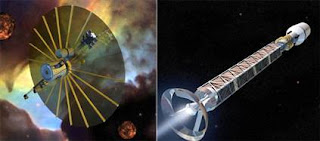
Mini Black Holes
If a radical new "braneworld" theory of gravity is correct, then scattered throughout our solar system are thousands of tiny black holes, each about the size of an atomic nucleus. Unlike their larger brethren, these mini-black holes are primordial leftovers from the Big Bang and affect space-time differently because of their close association with a fifth dimension.

Cosmic Microwave Background
Also known as the CMB, this radiation is a primordial leftover from the Big Bang that birthed the universe. It was first detected during the 1960s as a radio noise that seemed to emanate from everywhere in space. The CMB is regarded as one of the best pieces of evidence for the theoretical Big Bang. Recent precise measurements by the WMAP project place the CMB temperature at -455 degrees Fahrenheit (-270 Celsius).

Dark Matter
Scientists think it makes up the bulk of matter in the universe, but it can neither be seen nor detected directly using current technologies. Candidates range from light-weight neutrinos to invisible black holes. Some scientists question whether dark matter is even real, and suggest that the mysteries it was conjured to solve could be explained by a better understanding of gravity.

Exoplanets
Until about the early 1990s, the only known planets in the universe were the familiar ones in our solar system. Astronomers have since identified more than 319 extrasolar planets (as of October 2008). They range from gargantuan gas worlds whose masses are just shy of being stars to small, rocky ones orbiting dim, red dwarfs. Searches for a second Earth, however, have so far turned up empty. Astronomers generally believe that better technology is likely to eventually reveal several worlds similar to our own.

Gravity Waves
Gravity waves are distortions in the fabric of space-time predicted by Albert Einstein's theory of general relativity. The waves travel at the speed of light, but they are so weak that scientists expect to detect only those created during colossal cosmic events, such as black hole mergers like the one shown. LIGO and LISA are two detectors designed to spot the elusive waves.

Galactic Cannibalism
Like life on Earth, galaxies can "eat" each other and evolve over time. The Milky Way's neighbor, Andromeda, is currently dining on one of its satellites. More than a dozen star clusters are scattered throughout Andromeda, the cosmic remains of past meals. The image is from a simulation of Andromeda and our galaxy colliding, an event that will take place in about 3 billion years.

Neutrinos
Neutrinos are electrically neutral, virtually mass-less elementary particles that can pass through miles of lead unhindered. Some are passing through your body as you read this. These "phantom" particles are produced in the inner fires of burning, healthy stars as well as in the supernova explosions of dying stars. Detectors are being embedded underground, beneath the sea, or into a large chunk of ice as part of IceCube, a neutrino-detecting project.

Blogger's Note: The information and images are from MSNBC. This is presented with links to additional information for self-educational purposes only. No copyright infringement is intended.
That's all!
--->Susan
Quasars
These bright beacons shine to us from the edges of the visible universe and are reminders to scientists of our universe's chaotic infancy. Quasars release more energy than hundreds of galaxies combined. The general consensus is that they are monstrous black holes in the hearts of distant galaxies. This image is of quasar 3C 273, photographed in 1979.

Vacuum Energy
Quantum physics tells us that contrary to appearances, empty space is a bubbling brew of "virtual" subatomic particles that are constantly being created and destroyed. The fleeting particles endow every cubic centimeter of space with a certain energy that, according to general relativity, produces an anti-gravitational force that pushes space apart. Nobody knows what's really causing the accelerated expansion of the universe, however.

Anti-matter
Like Superman's alter-ego, Bizzaro, the particles making up normal matter also have opposite versions of themselves. An electron has a negative charge, for example, but its anti-matter equivalent, the positron, is positive. Matter and anti-matter annihilate each other when they collide and their mass is converted into pure energy by Einstein's equation E=mc2. Some futuristic spacecraft designs incorporate anti-matter engines.

Mini Black Holes
If a radical new "braneworld" theory of gravity is correct, then scattered throughout our solar system are thousands of tiny black holes, each about the size of an atomic nucleus. Unlike their larger brethren, these mini-black holes are primordial leftovers from the Big Bang and affect space-time differently because of their close association with a fifth dimension.

Cosmic Microwave Background
Also known as the CMB, this radiation is a primordial leftover from the Big Bang that birthed the universe. It was first detected during the 1960s as a radio noise that seemed to emanate from everywhere in space. The CMB is regarded as one of the best pieces of evidence for the theoretical Big Bang. Recent precise measurements by the WMAP project place the CMB temperature at -455 degrees Fahrenheit (-270 Celsius).

Dark Matter
Scientists think it makes up the bulk of matter in the universe, but it can neither be seen nor detected directly using current technologies. Candidates range from light-weight neutrinos to invisible black holes. Some scientists question whether dark matter is even real, and suggest that the mysteries it was conjured to solve could be explained by a better understanding of gravity.

Exoplanets
Until about the early 1990s, the only known planets in the universe were the familiar ones in our solar system. Astronomers have since identified more than 319 extrasolar planets (as of October 2008). They range from gargantuan gas worlds whose masses are just shy of being stars to small, rocky ones orbiting dim, red dwarfs. Searches for a second Earth, however, have so far turned up empty. Astronomers generally believe that better technology is likely to eventually reveal several worlds similar to our own.

Gravity Waves
Gravity waves are distortions in the fabric of space-time predicted by Albert Einstein's theory of general relativity. The waves travel at the speed of light, but they are so weak that scientists expect to detect only those created during colossal cosmic events, such as black hole mergers like the one shown. LIGO and LISA are two detectors designed to spot the elusive waves.

Galactic Cannibalism
Like life on Earth, galaxies can "eat" each other and evolve over time. The Milky Way's neighbor, Andromeda, is currently dining on one of its satellites. More than a dozen star clusters are scattered throughout Andromeda, the cosmic remains of past meals. The image is from a simulation of Andromeda and our galaxy colliding, an event that will take place in about 3 billion years.

Neutrinos
Neutrinos are electrically neutral, virtually mass-less elementary particles that can pass through miles of lead unhindered. Some are passing through your body as you read this. These "phantom" particles are produced in the inner fires of burning, healthy stars as well as in the supernova explosions of dying stars. Detectors are being embedded underground, beneath the sea, or into a large chunk of ice as part of IceCube, a neutrino-detecting project.

Blogger's Note: The information and images are from MSNBC. This is presented with links to additional information for self-educational purposes only. No copyright infringement is intended.
That's all!
--->Susan
25 October 2008
Watch Out In MacArthur Park
Sun Splits
A California photographer caught this mirage off the beach.

Atmospheric optics expert Les Cowley explains: "The California Coast is such a fertile place for sunset mirages, it is a wonder that it has any 'normal' ones! To form mirages like this you need air cooled by contact with a cold ocean current topped by warmer air from the land – a temperature inversion. The junction of the two air masses is the dark line above the horizon. The sun's rays are curved by passage between the layers to form the multiple images, two setting and one even rising!"
More Pretty Phenomenon from Atmospheric Optics

Light playing on water drops, dust or ice crystals in the atmosphere produces a host of visual spectacles – rainbows, halos, glories, coronas and many more. Some can be seen almost every day or so, some are once in a lifetime sights. Find out where to see them and how they form. Then seek and enjoy them outdoors.
Someone Left the Cake out in the Meteor Rain
"How many meteors can you count in these pictures?" asks Pierre Martin of Ottawa, Ontario. Answer: 16. "Those are the Orionids I saw on Oct. 23rd. Even two nights after the peak, the shower was still going strong!"

The beautiful flurry commenced on Oct 21st when Earth passed through a stream of debris from Halley's Comet. Meteors flew out of the constellation Orion in numbers exceeding 40 per hour--about twice the usual rate. This is the third year in a row the Orionids have surged in this fashion, suggesting a trend. "I'm sure that meteor enthusiasts around the world are looking forward to next year's display," says Martin. Mark your calendar: Oct. 21, 2009.
More Orionid Photos


Neighborhood News
Potentially Hazardous Asteroids (PHAs) are space rocks larger than approximately 100m that can come closer to Earth than 0.05 AU. None of the known PHAs is on a collision course with our planet, although astronomers are finding new ones all the time.
On October 25, 2008 there were 992 potentially hazardous asteroids.
Say Hello to Helios!

The STEREO (Ahead) spacecraft observed this visually stunning prominence eruption on Sept. 29, 2008 in the 304 wavelength of extreme UV light. It rose up and cascaded to the right over several hours, appearing something like a flag unfurling, as it broke apart and headed into space. The material observed is actually ionized Helium at about 60,000 degrees. Prominences are relatively cool clouds of gas suspended above the Sun and controlled by magnetic forces.
Erik Lehnsherr Speaks!

I found this cool site presented by the The Space Plasma Physics Group of the Marshall Space Flight Center in Alabama. The Lion Roars is an audio presentation of the sounds generated by the magnetosphere and how we discovered just what those strange noises were when we invented the telephone.
That's all!
--->Susan
A California photographer caught this mirage off the beach.

Atmospheric optics expert Les Cowley explains: "The California Coast is such a fertile place for sunset mirages, it is a wonder that it has any 'normal' ones! To form mirages like this you need air cooled by contact with a cold ocean current topped by warmer air from the land – a temperature inversion. The junction of the two air masses is the dark line above the horizon. The sun's rays are curved by passage between the layers to form the multiple images, two setting and one even rising!"
More Pretty Phenomenon from Atmospheric Optics

Light playing on water drops, dust or ice crystals in the atmosphere produces a host of visual spectacles – rainbows, halos, glories, coronas and many more. Some can be seen almost every day or so, some are once in a lifetime sights. Find out where to see them and how they form. Then seek and enjoy them outdoors.
Someone Left the Cake out in the Meteor Rain
"How many meteors can you count in these pictures?" asks Pierre Martin of Ottawa, Ontario. Answer: 16. "Those are the Orionids I saw on Oct. 23rd. Even two nights after the peak, the shower was still going strong!"
The beautiful flurry commenced on Oct 21st when Earth passed through a stream of debris from Halley's Comet. Meteors flew out of the constellation Orion in numbers exceeding 40 per hour--about twice the usual rate. This is the third year in a row the Orionids have surged in this fashion, suggesting a trend. "I'm sure that meteor enthusiasts around the world are looking forward to next year's display," says Martin. Mark your calendar: Oct. 21, 2009.
More Orionid Photos


Neighborhood News
Potentially Hazardous Asteroids (PHAs) are space rocks larger than approximately 100m that can come closer to Earth than 0.05 AU. None of the known PHAs is on a collision course with our planet, although astronomers are finding new ones all the time.
On October 25, 2008 there were 992 potentially hazardous asteroids.
Say Hello to Helios!

The STEREO (Ahead) spacecraft observed this visually stunning prominence eruption on Sept. 29, 2008 in the 304 wavelength of extreme UV light. It rose up and cascaded to the right over several hours, appearing something like a flag unfurling, as it broke apart and headed into space. The material observed is actually ionized Helium at about 60,000 degrees. Prominences are relatively cool clouds of gas suspended above the Sun and controlled by magnetic forces.
Erik Lehnsherr Speaks!

I found this cool site presented by the The Space Plasma Physics Group of the Marshall Space Flight Center in Alabama. The Lion Roars is an audio presentation of the sounds generated by the magnetosphere and how we discovered just what those strange noises were when we invented the telephone.
That's all!
--->Susan
Subscribe to:
Posts (Atom)