Showing posts with label exoplanets. Show all posts

05 January 2010

Photos from Space

Not much in the way of news today, so here are some photos to tickle your fancy.

Enjoy!

--->Susan


Artist's concept shows a cloudy Jupiter-like planet that orbits very close to its fiery hot star.


X-rays from Chandra are shown in blue and are overlaid on an optical image from the Hubble Space Telescope. The Chandra observations show that this object is a so-called ultraluminous X-ray source (ULX). An unusual class of objects, ULXs emit more X-rays than stars, but less than quasars. Their exact nature has remained a mystery, but one suggestion is that some ULXs are black holes with masses between about a hundred and a thousands times that of the Sun.


This image of a cluster of rocks labeled 'Rock Garden' is where NASA's Mars Exploration Rover Spirit became embedded in April 2009. The Spirit and Opportunity rovers landed on the Red Planet in January 2004 for what was to be a 90-day mission, but which has lasted 6 Earth years, or 3.2 Mars years. During this time, Spirit has found evidence of a steamy and violent environment on ancient Mars that is quite different from the wet and acidic past documented by Opportunity, which has been operating successfully as it explores halfway around the planet.


This natural-color image of Mayon Volcano was captured on Dec. 15, 2009, by the Advanced Land Imager on NASA's Earth Observing-1 (EO-1) satellite. A small plume of ash and steam is blowing west from the summit. Dark-colored lava or debris flows from previous eruptions streak the flanks of the mountain. A ravine on the southeast slope is occupied by a particularly prominent lava or debris flow.


The Cat's Eye Nebula taken by Hubble. The nebula is in the constellation of Draco approximately 3,000 light years from Earth.


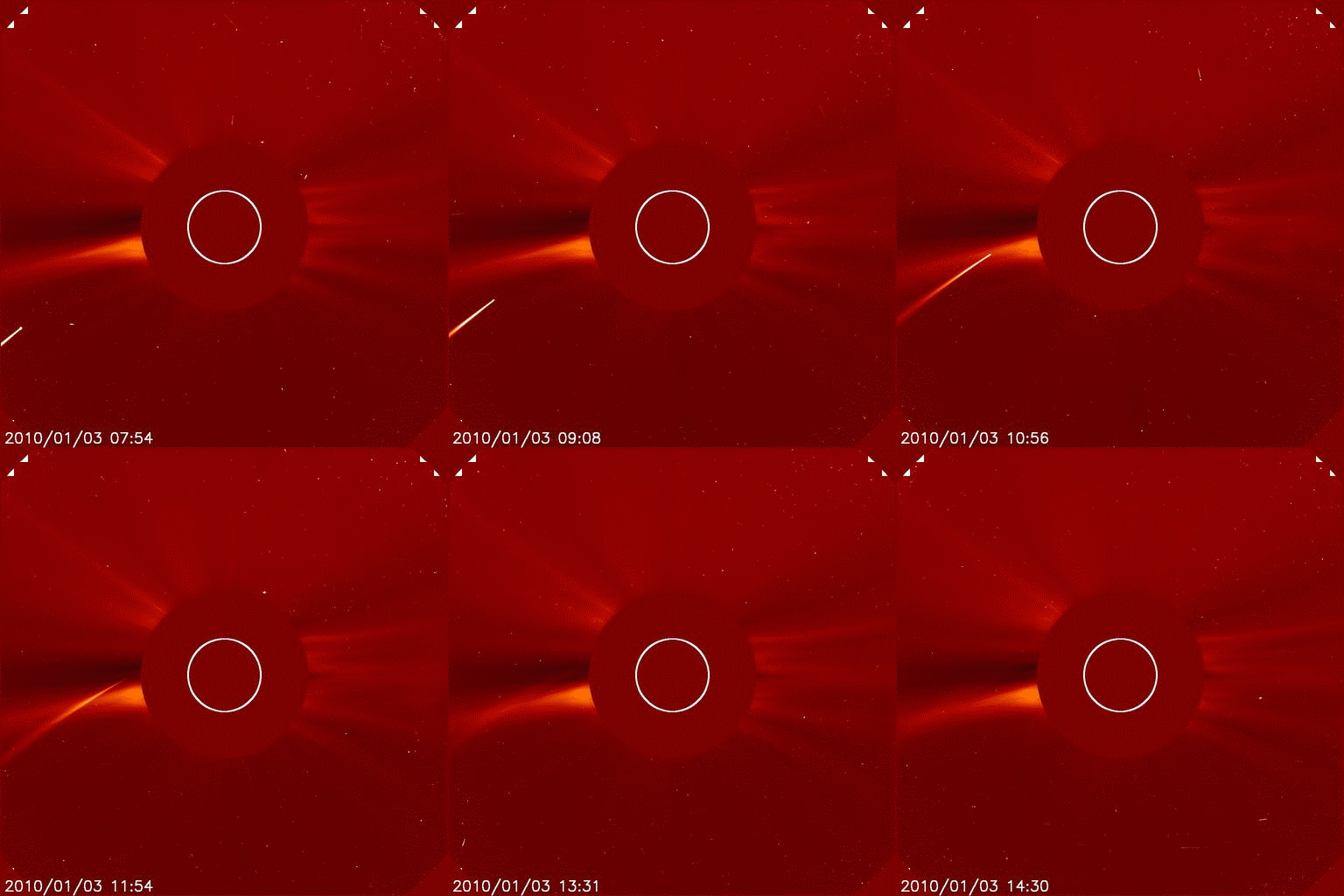
Death of a comet. NASA's SOHO observatory took these series of shots of a comet getting just a bit too up close and personal with the sun. Comet goes in, but it doesn't come out. Oops. One less dirty snowball in the solar system to worry about.

04 January 2010

Kepler Scores!


As reported here in Mystical Musings the other day, NASA said there would be an announcement regarding the Kepler space observatory launched last March to search for terrestrial-type planets. Today, they announced that the mission is already a success and five new exoplanets can be added to our catalogue.

Named Kepler 4b, 5b, 6b, 7b and 8b, the planets are all of high mass and extreme temperature and range in size from similar to Neptune to Jupiter and temperatures from 2,200 to 3,000 degrees Fahrenheit. That's a heck of a lot hotter than the temperature required to burn a book.


Kepler is expected to keep looking for planets until November 2012 and as the mission's head stated in the news briefing today, "The Kepler observations will tell us whether there are many stars with planets that could harbor life, or whether we might be alone in our galaxy."


Click here for more info on Kepler and its mission. The mission is named after German mathematician, astronomer and astrologer Johannes Kepler best known for his laws of planetary motion which led the way for Isaac Newton's theory of universal gravitation. Kepler proved that planets moved around the sun in elliptical orbits and not the circular orbits proposed by Copernicus. Along with Newton, Kepler gave rise to modern astronomy and physics.

Enjoy!

--->Susan

02 December 2008

News from the 'Verse

Aurorae on Mars

The aurorae phenomenon has been confirmed on Mars by the infrared atmospheric spectronometer on the Mars Express Orbiter. The lights are not visible in regular light. Mars doesn't generate a planet-wide magentic field like here on Earth, so our aurorae will always be prettier.


Artist's rendition of the Mars Express Orbiter


Intersystem Visitor

Comet Machholz 1, discovered in 1986, has such a bizarre chemical makeup that scientists now believe it may have come from beyond our solar system. David Schleicher, a planetary astronomer at Lowell Observatory in Arizona.believes that Machholz 1 could be an interstellar interloper. He's found that the comet contains much less of a carbon-nitrogen molecule called cyanogen compared with the average found in other comets.


This image taken by the ESA-NASA sunwatching spacecraft SOHO reveals Comet Machholz 1 close to the sun on Jan. 8, 2002. SOHO's coronograph hid the bright sun, the size of which is shown by the inner ring. Credit: SOHO/LASCO (ESA & NASA).


Exoplanetary News

A newly discovered exoplanet nearly six times the mass of Jupiter was discovered orbiting the red giant star HD 102272, which is located 1,200 light-years away in the constellation Leo. The researchers detected the planet with the Hobby-Eberly Telescope of McDonald Observatory in Texas. They used the radial velocity method, which involves measuring the slight wobbles of a star caused by the tug of an orbiting planet.


This artist's impression shows a red supergiant engulfing a Jupiter-like planet as it expands. The red giant HD 102272 will likely not engulf its planet for another 100 million years when it begins to mushroom dramatically. Credit: NASA


Great Conjunction

I hope y'all got a good look outside last night at the amazing skyshow of the Moon, Jupiter and Venus. I tried to get some pics, but forgot to set up the tripod in time so I missed it. However, here are some shots for your enjoyment.


Lunar Conjunction

Romanian photographer Stanescu Octavian took this picture of the moon running over Venus. These happen just twice a year with the next being February 28, 2009 and will be wonderfully visible here in North America.


NEO News

On December 2, 2008 there were 1002 potentially hazardous asteroids.
Dec. 2008 Earth-asteroid encounters:
Asteroid
Date(UT)
Miss Distance
Mag.
Size
2008 WY94
Dec. 5
3.2 LD
19
35 m
2008 WG14
Dec. 5
4.8 LD
17
49 m
2006 VB14
Dec. 14
36 LD
15
795 m
2008 EV5
Dec. 23
8.4 LD
13
435 m


That's all!

--->Susan

13 November 2008

We Are Not Alone

NASA has released photographs taken by the HST of another planet in another solar system.


Wow!

This is not an infrared image, this is not a radio image, and this is not an artist's rendition. This is an actual visible-light photograph of another planet in another solar system.

Wow again!

The system is a bright star called Fomalhaut, about 25 light-years from us in the constellation Piscis Australis, or the "Southern Fish." Scientists have long suspected their first glimpse of another planet would be in this system since data suggested a large body was causing gravitational distortions to a cloud of dust orbiting the star which is very similar to our Kuiper Belt.

Says one of the scientists on the project: "Fomalhaut is the gift that keeps on giving. Following the unexpected discovery of its dust ring, we have now found an exoplanet at a location suggested by analysis of the dust ring's shape. The lesson for exoplanet hunters is 'follow the dust'."

NASA has ambition plans for further study of the Fomalhaut system. They're planning on launching the James Webb Space Telescope in 2013. Its mission will be to make coronagraphic observations of Fomalhaut in the near- and mid-infrared. Webb will be able to hunt for other planets in the system and probe the region interior to the dust ring for structures such as an inner asteroid belt.


That's all!

--->Susan

29 October 2008

The Strangest Things in Space

MSNBC's Technology and Science site has put together a list of some of the strangest things in space.

Quasars

These bright beacons shine to us from the edges of the visible universe and are reminders to scientists of our universe's chaotic infancy. Quasars release more energy than hundreds of galaxies combined. The general consensus is that they are monstrous black holes in the hearts of distant galaxies. This image is of quasar 3C 273, photographed in 1979.


Vacuum Energy

Quantum physics tells us that contrary to appearances, empty space is a bubbling brew of "virtual" subatomic particles that are constantly being created and destroyed. The fleeting particles endow every cubic centimeter of space with a certain energy that, according to general relativity, produces an anti-gravitational force that pushes space apart. Nobody knows what's really causing the accelerated expansion of the universe, however.


Anti-matter

Like Superman's alter-ego, Bizzaro, the particles making up normal matter also have opposite versions of themselves. An electron has a negative charge, for example, but its anti-matter equivalent, the positron, is positive. Matter and anti-matter annihilate each other when they collide and their mass is converted into pure energy by Einstein's equation E=mc2. Some futuristic spacecraft designs incorporate anti-matter engines.


Mini Black Holes

If a radical new "braneworld" theory of gravity is correct, then scattered throughout our solar system are thousands of tiny black holes, each about the size of an atomic nucleus. Unlike their larger brethren, these mini-black holes are primordial leftovers from the Big Bang and affect space-time differently because of their close association with a fifth dimension.


Cosmic Microwave Background

Also known as the CMB, this radiation is a primordial leftover from the Big Bang that birthed the universe. It was first detected during the 1960s as a radio noise that seemed to emanate from everywhere in space. The CMB is regarded as one of the best pieces of evidence for the theoretical Big Bang. Recent precise measurements by the WMAP project place the CMB temperature at -455 degrees Fahrenheit (-270 Celsius).


Dark Matter

Scientists think it makes up the bulk of matter in the universe, but it can neither be seen nor detected directly using current technologies. Candidates range from light-weight neutrinos to invisible black holes. Some scientists question whether dark matter is even real, and suggest that the mysteries it was conjured to solve could be explained by a better understanding of gravity.


Exoplanets

Until about the early 1990s, the only known planets in the universe were the familiar ones in our solar system. Astronomers have since identified more than 319 extrasolar planets (as of October 2008). They range from gargantuan gas worlds whose masses are just shy of being stars to small, rocky ones orbiting dim, red dwarfs. Searches for a second Earth, however, have so far turned up empty. Astronomers generally believe that better technology is likely to eventually reveal several worlds similar to our own.


Gravity Waves

Gravity waves are distortions in the fabric of space-time predicted by Albert Einstein's theory of general relativity. The waves travel at the speed of light, but they are so weak that scientists expect to detect only those created during colossal cosmic events, such as black hole mergers like the one shown. LIGO and LISA are two detectors designed to spot the elusive waves.


Galactic Cannibalism

Like life on Earth, galaxies can "eat" each other and evolve over time. The Milky Way's neighbor, Andromeda, is currently dining on one of its satellites. More than a dozen star clusters are scattered throughout Andromeda, the cosmic remains of past meals. The image is from a simulation of Andromeda and our galaxy colliding, an event that will take place in about 3 billion years.


Neutrinos

Neutrinos are electrically neutral, virtually mass-less elementary particles that can pass through miles of lead unhindered. Some are passing through your body as you read this. These "phantom" particles are produced in the inner fires of burning, healthy stars as well as in the supernova explosions of dying stars. Detectors are being embedded underground, beneath the sea, or into a large chunk of ice as part of IceCube, a neutrino-detecting project.


Blogger's Note: The information and images are from MSNBC. This is presented with links to additional information for self-educational purposes only. No copyright infringement is intended.

That's all!

--->Susan
 
Add to Technorati Favorites